
Dog Kennel Space Calculator: USDA Floor Space and Height Minimums
Dog kennel space calculator: enter your dog's length and height to get the USDA minimum floor space and headroom for licensed kennels, and how to read it.
Affiliate disclosure: product links on this page go to Amazon or to the maker's own store. As an Amazon Associate we earn from qualifying purchases, at no extra cost to you; links to makers' own stores earn us nothing. No retailer or brand sees our picks before they are published or has any say in them. How we choose.
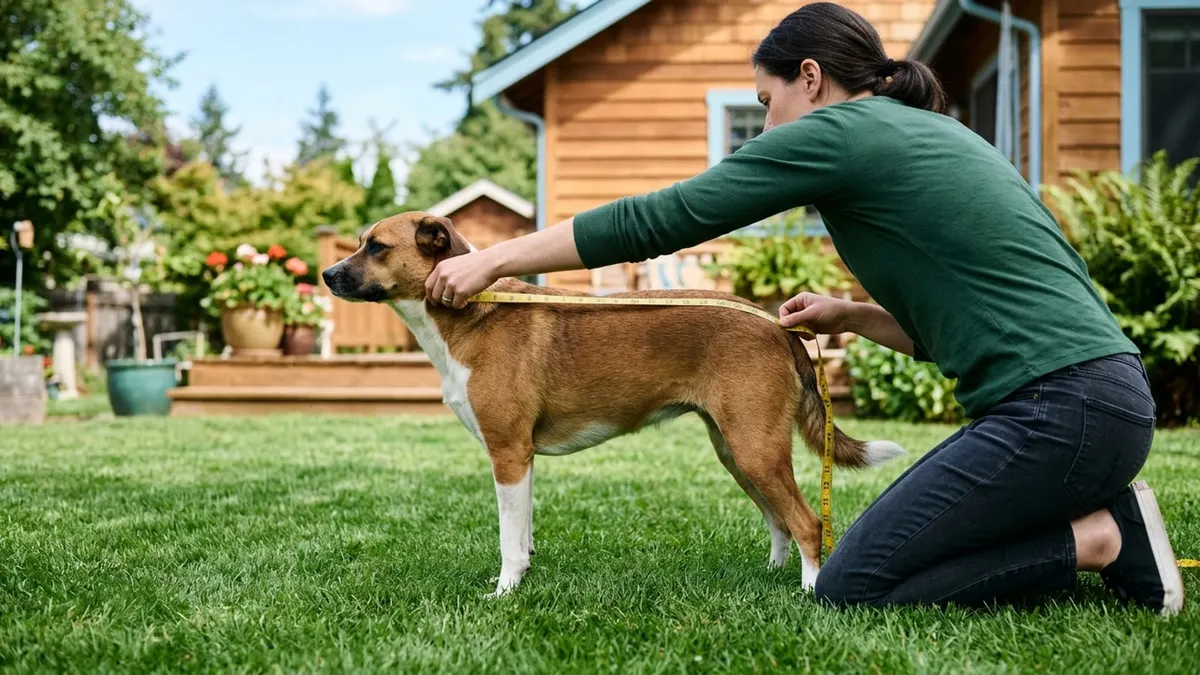
Enter your dog's length from the tip of the nose to the base of the tail, its height at the top of the head when standing, and the number of dogs. The calculator applies the US Department of Agriculture's formula for licensed kennels in 9 CFR 3.6: length in inches plus 6, squared, divided by 144, in square feet per dog, with at least 6 inches of headroom above the tallest dog. That rule binds dealers, exhibitors and research facilities, not pet owners, and it is a minimum. Read the answer as the least a dog may legally be given, and build bigger.
How much kennel space does your dog need?
USDA minimum floor space
9.0 sq ft
One dog
Twice the minimum
18.0 sq ft
The 9 CFR 3.8 exercise threshold
Minimum interior height
34 in
6 in above the head
Square side at the minimum
3.0 ft
For comparison with kennel sizes
Uses the USDA Animal Welfare Act minimum for licensed facilities (9 CFR 3.6): floor space per dog = (body length in inches + 6) squared, in square inches; height at least 6 inches above the dog's head standing. Measure length from the tip of the nose to the base of the tail. These are legal minimums for commercial kennels, not a recommendation for a home run: a yard kennel where a dog spends hours should be far bigger.
Worked example
A dog 30 inches long: 30 plus 6 is 36, and 36 squared is 1,296 square inches. Divided by 144, that is 9 square feet, a square 3 feet on a side. If its head stands 28 inches off the ground, the enclosure must be at least 34 inches high inside.
| Dog length | Minimum floor | Twice the minimum | As a square |
|---|---|---|---|
| 18 in | 4.0 sq ft | 8.0 sq ft | 2 ft x 2 ft |
| 24 in | 6.25 sq ft | 12.5 sq ft | 2.5 ft x 2.5 ft |
| 30 in | 9.0 sq ft | 18.0 sq ft | 3 ft x 3 ft |
| 36 in | 12.25 sq ft | 24.5 sq ft | 3.5 ft x 3.5 ft |
| 42 in | 16.0 sq ft | 32.0 sq ft | 4 ft x 4 ft |
The last column is the side of a square with the minimum area. The figures are our arithmetic from the formula.
Read it as a floor, not a goal
Nine square feet is a space in which a 30 inch dog can stand, turn round and lie down, which is what the same rule asks for in words: room to turn about freely, to stand, sit and lie in a comfortable, normal position, and to walk in a normal manner. It is not room to trot. The exercise rule, 9 CFR 3.8, says a dog kept alone in less than twice the minimum must be given regular exercise outside the pen, and lists twice the minimum as one way of providing the opportunity. Even doubled, the numbers are small beside any kennel sold for a yard. A 10 by 10 foot kennel is 100 square feet.
Local rules can be much larger
Cities and counties set their own standards for dogs kept outdoors. AKC notes that many municipalities regulate the amount of outdoor space a dog needs, sometimes requiring upwards of 200 square feet per dog. That is sixteen times the federal minimum for a 36 inch dog. Look up your own ordinance before you buy or build.
More than one dog
The calculator multiplies the per-dog figure by the number of dogs. For group housing, the exercise rule accepts a pen that provides in total at least 100 percent of the space each dog would need on its own. The federal rules add conditions that matter more than area: dogs sharing an enclosure must be compatible, and aggressive dogs are housed separately. MSD's veterinary manual says dogs housed together need enough space for all of them, or separate shelters.
How to measure
- Length: tip of the nose to the base of the tail, with the dog standing. Do not include the tail.
- Height: floor to the top of the head, with the dog in a normal standing position.
Kennels are compared on outdoor kennels, and what goes under them on kennel flooring. For a fenced run, the run fence calculator counts panels.
Frequently asked questions
How big should a dog kennel be?
The federal minimum for licensed kennels is the dog's length in inches plus 6, squared, divided by 144: 9 square feet for a 30 inch dog. That is a legal floor for regulated facilities. Yard kennels are far larger, and some municipalities require upwards of 200 square feet per dog, according to AKC.
How do I measure my dog for a kennel?
Measure length from the tip of the nose to the base of the tail, not including the tail, and height to the top of the head, with the dog standing normally. The federal height rule is 6 inches above the head of the tallest dog.
Do USDA kennel rules apply to pet owners?
No. 9 CFR Part 3 sets standards for licensed dealers, exhibitors and research facilities under the Animal Welfare Act. Pet owners are covered by state and local law. The formula is useful as the lowest figure anyone regulates to.
How much space for two dogs?
Add each dog's minimum together. The federal exercise rule accepts group housing that gives at least 100 percent of the space each dog would need alone. The dogs must also be compatible.
What does twice the minimum mean?
Under 9 CFR 3.8, a dog housed alone in less than twice its minimum floor space must be given regular exercise outside the pen. Twice the minimum is listed as one way of providing the opportunity to exercise.
How high should a kennel be?
At least 6 inches higher than the head of the tallest dog standing, under the federal rule. Walk-in yard kennels are about 6 feet high so a person can stand inside to clean.
Sources
- 9 CFR 3.6: Primary enclosures, Legal Information Institute, Cornell Law School
- 9 CFR 3.8: Exercise for dogs, Legal Information Institute, Cornell Law School
- How Long Can You Keep Your Dog Outside?, American Kennel Club
- Table: Special Needs of Outdoor Dogs, MSD Veterinary Manual
Cover image: Illustration: Dog Kennel Review (AI-generated)
Related guides
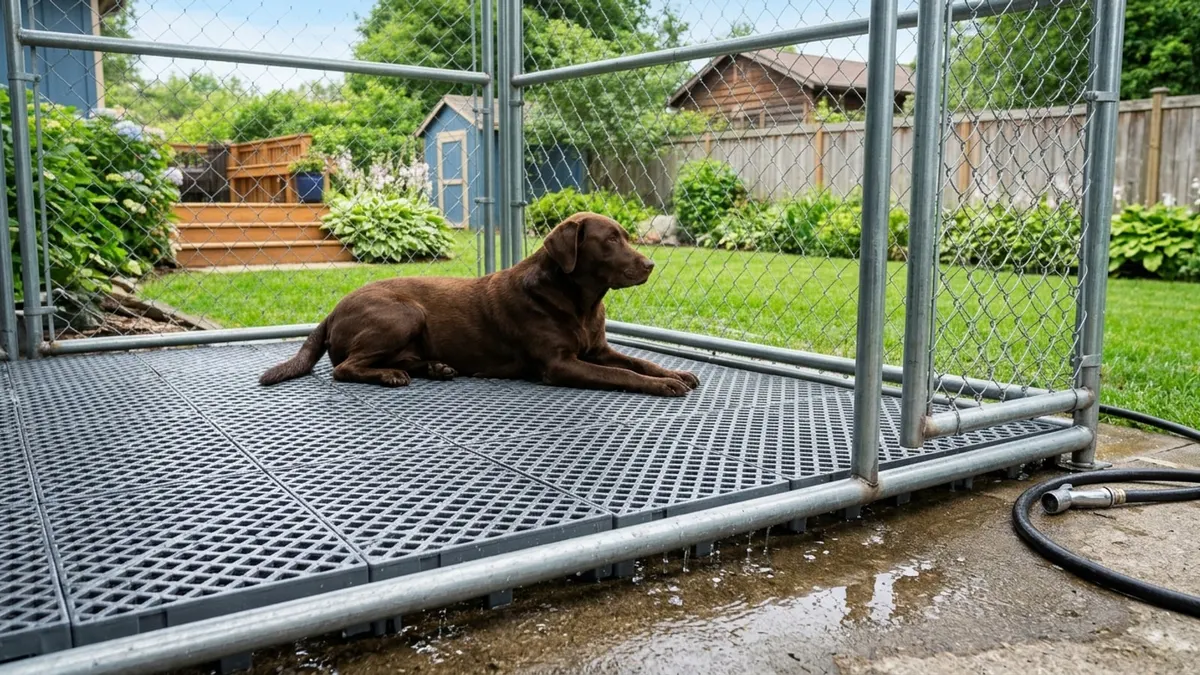
Dog Kennel Flooring: Interlocking Tiles That Drain and Clean Easily (2026)
Raised tiles that keep a kennel floor dry, and what to put under them.
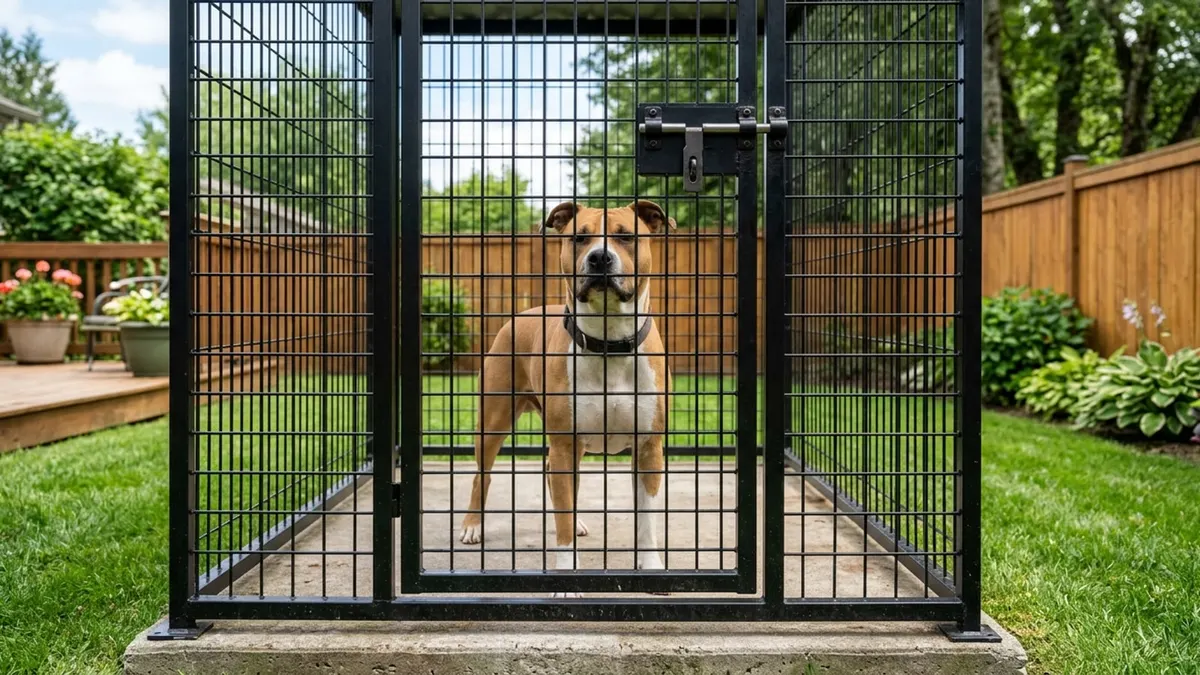
Heavy Duty Dog Kennels for Escape Artists and Strong Dogs (2026)
Thicker mesh, better locks and anchoring for dogs that test their kennel.
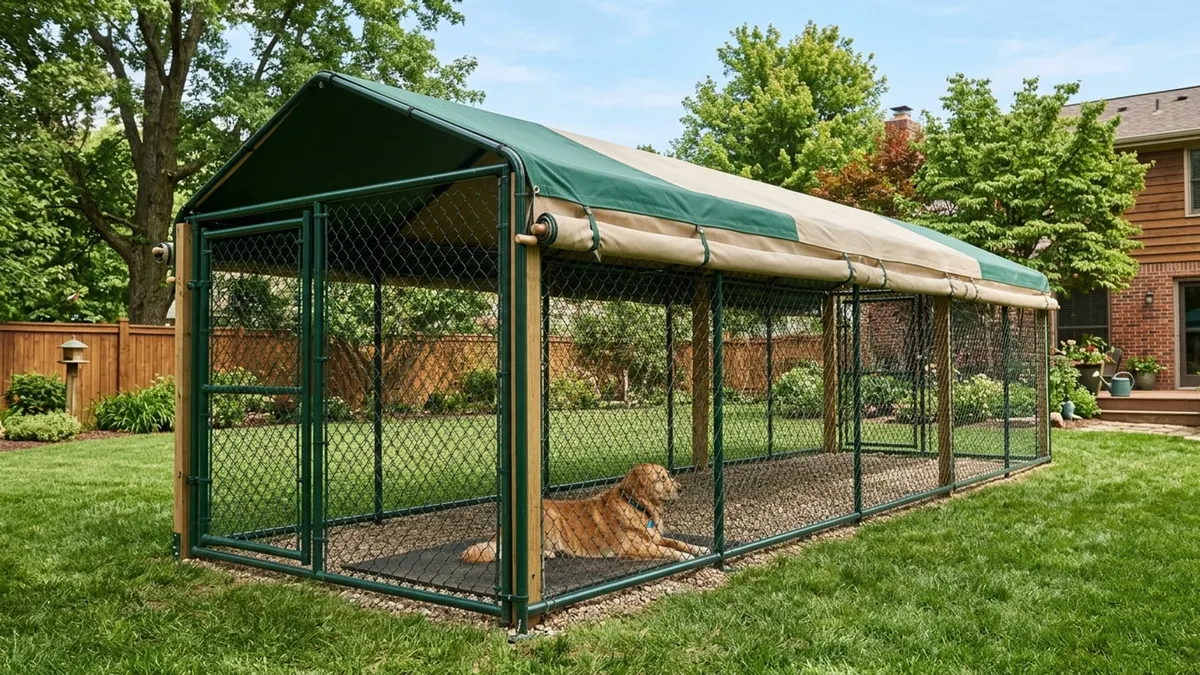
Outdoor Dog Kennels With Roofs: Shade and Rain Protection Built In (2026)
Kennels with built-in roofs and covers, from 6.5 to 20 feet long.