
Dog Run Fence Calculator: Panels, Gates and Area for Your Run
Dog run fence calculator: enter the run's length, width, panel width and gates to get the panels you need, the built size, area and perimeter.
Affiliate disclosure: product links on this page go to Amazon or to the maker's own store. As an Amazon Associate we earn from qualifying purchases, at no extra cost to you; links to makers' own stores earn us nothing. No retailer or brand sees our picks before they are published or has any say in them. How we choose.
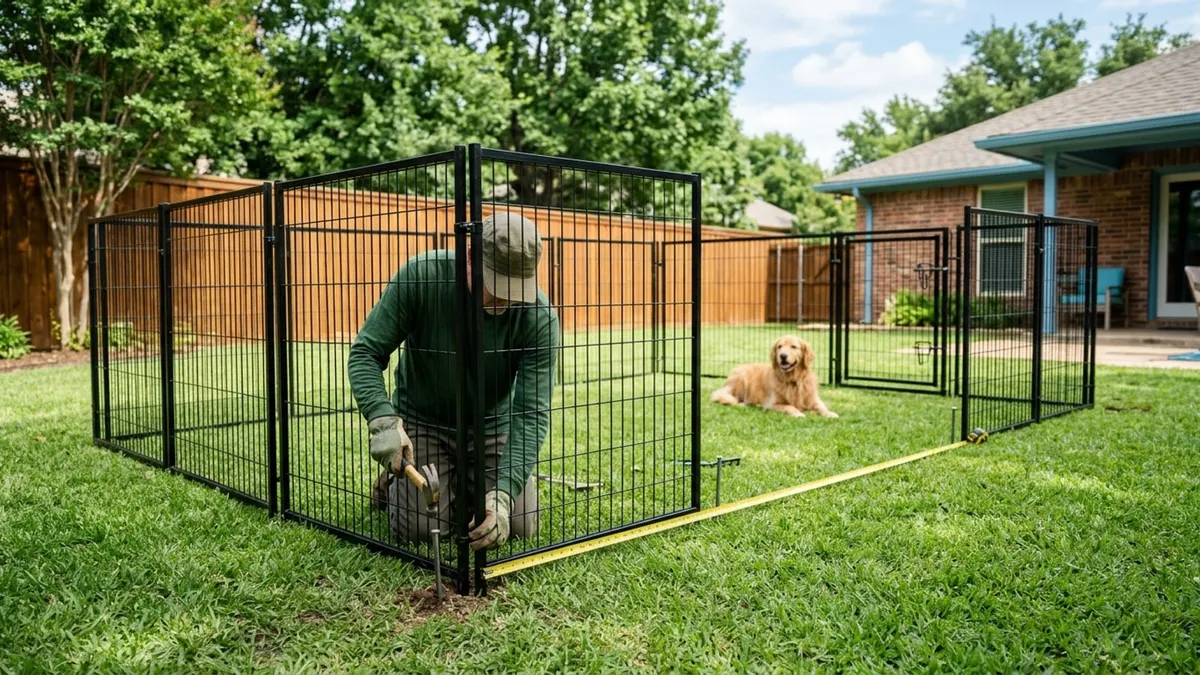
Enter the length and width you want, the width of one fence panel and the number of gates. The calculator rounds each side up to a whole number of panels, counts a gate as taking the place of one panel, and gives the size the run will actually be, with its area and perimeter. It is geometry and nothing more. It does not know your kit's corner posts or your local fence rules, so check both.
How many panels does your dog run need?
Fence panels
9
3 per long side, 2 per short side, minus gates
Gate panels
1
Enclosed area
150 sq ft
As built: 15 x 10 ft
Perimeter
50 ft
Pure geometry for a rectangular run: panels per side are rounded up, and each gate replaces one panel. Check your kit's panel width (often 5 ft on modular kennels and about 2 to 3 ft on playpens) and that the corners and posts match the maker's design. Add the USDA floor-space check from the kennel space calculator.
Worked example
A run 15 feet long and 10 feet wide in 5 foot panels: three panels on each long side and two on each short side, ten in all. With one gate, that is nine fence panels and one gate panel. The built size is exactly 15 by 10 feet, 150 square feet, with a perimeter of 50 feet.
Change the panel to 4 feet and the long sides need four panels each, since 15 divided by 4 rounds up. The run becomes 16 by 12 feet and takes fourteen panels.
Same fence, different shape
One set of panels encloses different areas depending on how it is laid out, and the difference is larger than most people expect.
| Layout | Perimeter | Area | Good for |
|---|---|---|---|
| 10 x 10 ft | 40 ft | 100 sq ft | Resting; the most floor for the fence |
| 5 x 15 ft | 40 ft | 75 sq ft | Running; a longer straight |
| 4 x 16 ft | 40 ft | 64 sq ft | A side yard |
The Lucky Dog 2-in-1 kit is sold on exactly this choice: it builds as 10 by 10 or as 5 by 15 from the same panels. A square always encloses the most area; a long run gives the dog a straight to move along.
Panel widths in real kits
By the makers' listings, folding exercise pens use panels 24 inches wide (MidWest and Amazon Basics), and the 16-panel VISCOO pen builds a square 100 inches on a side, which works out to 25 inches a panel. Walk-in kennel kits are sold by their built size, not their panel width, so read the listing or the manual before entering a figure. Enter widths in feet: 24 inches is 2.
Check the answer against the dog
Area is the number to compare with a standard. The federal minimum for licensed kennels is the dog's length in inches plus 6, squared, divided by 144, in square feet, and a pen with at least twice that counts as giving room to exercise. The kennel space calculator works it out. Local law may ask for more. AKC notes that some municipalities require upwards of 200 square feet per dog, which is a 10 by 20 foot run.
Tips
- Round up, not down. A run a panel longer costs one panel; a run too short costs the dog.
- Put the gate where you will carry the hose and the waste bucket, and where the dog cannot crowd it.
- Allow for posts and corners. Some kits join panels edge to edge and others add a post width at each corner.
- Plan the base and the shade before the fence goes up: see how to set up a dog run.
Frequently asked questions
How many fence panels do I need for a dog run?
Divide each side by the panel width and round up, then add the four sides together. A 15 by 10 foot run in 5 foot panels takes ten, one of which can be the gate.
How do I work out the area of a dog run?
Multiply the built length by the built width. A 5 by 15 foot run is 75 square feet; a 10 by 10 is 100. The calculator uses the built size, after rounding up to whole panels.
Is a square or a long run better?
A square encloses the most area for a given length of fence: 40 feet makes 100 square feet as a 10 by 10 but 75 as a 5 by 15. A long run gives a dog a straight to move along. Choose by whether the dog rests there or exercises there.
How wide are dog fence panels?
Folding exercise pens from MidWest and Amazon Basics use 24 inch panels. Walk-in kennel kits vary and are sold by built size, so check the listing or manual for the panel width.
Does a gate count as a panel?
In the calculator, yes: each gate takes the place of one fence panel. Check that your kit's gate panel is the same width as its fence panels.
How big does a dog run have to be by law?
Pet owners are governed by state and local law, which varies; AKC notes some municipalities require upwards of 200 square feet per dog. The federal formula for licensed kennels gives a much smaller minimum.
Sources
- 9 CFR 3.6: Primary enclosures, Legal Information Institute, Cornell Law School
- 9 CFR 3.8: Exercise for dogs, Legal Information Institute, Cornell Law School
- How Long Can You Keep Your Dog Outside?, American Kennel Club
Cover image: Illustration: Dog Kennel Review (AI-generated)
Related guides
Dog Runner Cables: Overhead Trolley Systems for Supervised Yard Time (2026)
Overhead trolleys that give room to roam with fewer tangles than a stake.
Dog Tie-Out Stakes: Spiral and Swivel Stakes for Camping and the Yard (2026)
Stakes that hold in sand, clay and rock, and how to use them safely.
How to Set Up a Dog Run: Site, Base, Fencing, Shade and Water
From picking the spot to the first clean-out.