
Dog Tie-Out Stakes: Spiral and Swivel Stakes for Camping and the Yard (2026)
Dog tie-out stakes: ROYAL PAW, TOPKNOT, Petbobi and WePet compared on design, soil, stated dog weight and cable, plus the tethering laws that apply.
Affiliate disclosure: product links on this page go to Amazon or to the maker's own store. As an Amazon Associate we earn from qualifying purchases, at no extra cost to you; links to makers' own stores earn us nothing. No retailer or brand sees our picks before they are published or has any say in them. How we choose.
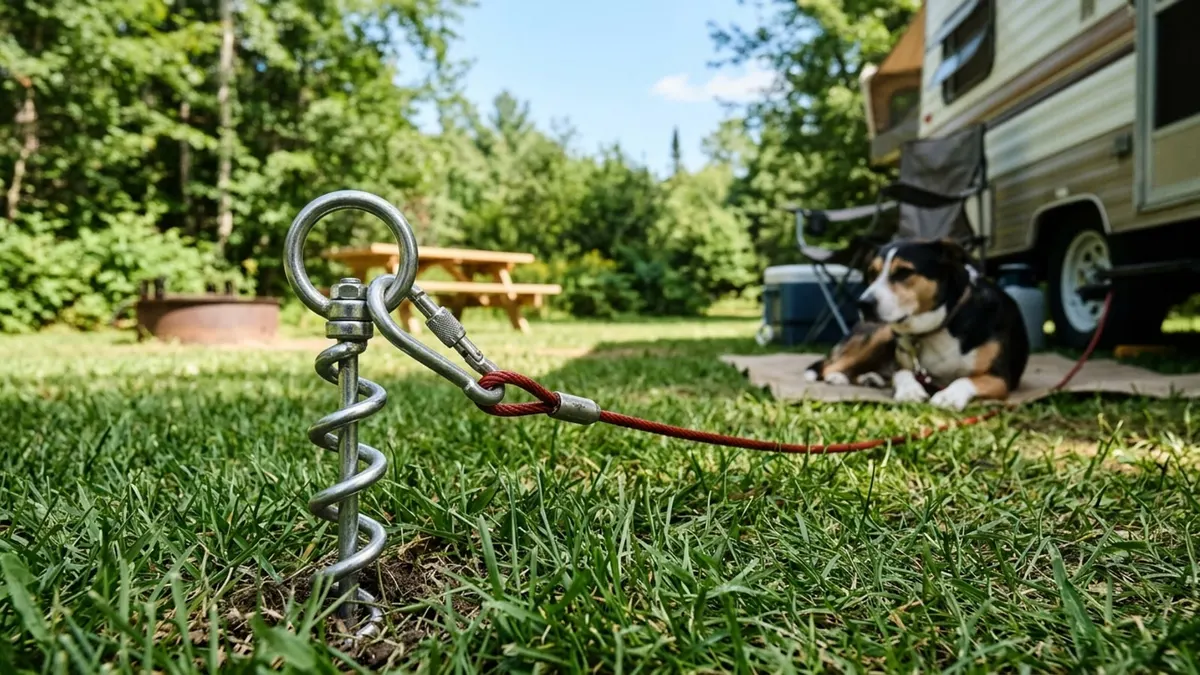
For a campsite or a short spell in an unfenced yard, the stake to start with is the ROYAL PAW tie-out stake: curved double blades behind a spiral tip, an installation tool for hard soil, and a stated hold for dogs up to 210 lb. Match the stake to your ground. A spiral holds in soil and sand; on rock or hardpan only a bolted base does. A stake is the most restricted way to keep a dog. Twenty-three states and the District of Columbia regulate tethering, and the rules bite hardest on a dog tied to a fixed point.
Our top picks at a glance
- ROYAL PAW tie-out stake for dogs up to 210 lb
Design: Curved double blades, spiral tip · Soil: Sandy and clay soils; tool for stubborn ground · Dog weight (maker): Up to 210 lb · Cable: Not included
- TOPKNOT 30 ft tie-out cable and swivel stake
Design: Aluminum base, 304 stainless swivel · Soil: Rock and hard ground, bolted · Dog weight (maker): Up to 150 lb · Cable: 30 ft, with screw-lock carabiners
- Petbobi 30 ft tie-out cable and stake
Design: 16 in spiral, rubber handle · Soil: Lawn and soft ground · Dog weight (maker): 20 to 120 lb · Cable: 30 ft, 4 mm, PVC coated
- WePet spiral tie-out stake
Design: 16 in spiral · Soil: Sandy soil, loose ground · Dog weight (maker): Up to 100 lb · Cable: Not included
| Pick | Design | Soil | Dog weight (maker) | Cable | Buy |
|---|---|---|---|---|---|
| ROYAL PAW tie-out stake for dogs up to 210 lbBest overall | Curved double blades, spiral tip | Sandy and clay soils; tool for stubborn ground | Up to 210 lb | Not included | Amazon |
| TOPKNOT 30 ft tie-out cable and swivel stakeBest for hard ground | Aluminum base, 304 stainless swivel | Rock and hard ground, bolted | Up to 150 lb | 30 ft, with screw-lock carabiners | Amazon |
| Petbobi 30 ft tie-out cable and stakeBest kit | 16 in spiral, rubber handle | Lawn and soft ground | 20 to 120 lb | 30 ft, 4 mm, PVC coated | Amazon |
| WePet spiral tie-out stakeSimplest | 16 in spiral | Sandy soil, loose ground | Up to 100 lb | Not included | Amazon |
Best overall
ROYAL PAW tie-out stake for dogs up to 210 lb
A stake with curved double blades and a spiral tip, plus an installation tool, for dogs up to 210 lb by the maker's figure.
- Design
- Curved double blades, spiral tip
- Soil
- Sandy and clay soils; tool for stubborn ground
- Dog weight (maker)
- Up to 210 lb
- Cable
- Not included
Pros
- Blades resist pull-out better than a plain spiral (maker's design claim)
- Installation tool in the kit
- Highest stated dog weight here
Cons
- No cable: buy one separately
- Warranty needs registration
ROYAL PAW lists a stake designed for heavy pullers, holding large breeds up to 210 lb by its own figure. Curved double blades sit behind a spiral tip, which the maker says lets it go in smoothly and in under a minute.
It is offered for any ground, including sandy and clay soils, and a metal installation tool is included for stubborn soil. The item data gives a length of 15.5 inches and a weight of about 4 lb.
No cable comes with it. An extended warranty is available on registration, and the maker says it replies to questions within 12 hours. The 210 lb figure is not tied to a named test or soil.
Best for hard ground
TOPKNOT 30 ft tie-out cable and swivel stake
A rotating aluminum base fixed by six 10 inch bolt anchors, with a 30 foot cable, for rock and hard ground.
- Design
- Aluminum base, 304 stainless swivel
- Soil
- Rock and hard ground, bolted
- Dog weight (maker)
- Up to 150 lb
- Cable
- 30 ft, with screw-lock carabiners
Pros
- Works where a spiral will not go in
- Base turns through 360 degrees
- 16-month warranty
Cons
- Needs a hammer and six anchors: not quick to move
- 1,500 lb pull figure names no test
TOPKNOT lists a different kind of anchor: a base of aluminum alloy with a 304 stainless steel swivel, fixed by hammering six 10 inch bolt anchors into rock or hard ground. The maker says the system withstands 1,500 lb of pull and suits dogs up to 150 lb, tested on stable ground.
The ring rotates through 360 degrees so the cable does not wind up. A 30 foot cable is included, and the maker says it upgraded the cable's tension and changed the carabiners to screw-lock ones in August 2025.
Six anchors make this a semi-permanent fitting, the opposite of a camping stake. It is the one to choose where the ground defeats a spiral. The warranty is 16 months.
A 16 inch spiral stake with a rubber handle and a 30 foot coated cable with a 5 inch shock spring.
- Design
- 16 in spiral, rubber handle
- Soil
- Lawn and soft ground
- Dog weight (maker)
- 20 to 120 lb
- Cable
- 30 ft, 4 mm, PVC coated
Pros
- Stake, cable and spring in one box
- Maker says to clip to a harness
- Swivel clips at both ends
Cons
- Spiral only: soft ground
- 120 lb limit
Petbobi lists a kit: a 16 inch stainless steel spiral stake with a rubber handle that screws in and out by hand, and a 30 foot cable 4 mm thick, steel wire under a PVC coat.
A 5 inch shock-absorbing spring at the end of the tether is there, the maker says, to buffer a sudden lunge and prevent choking or neck injury. Clips at both ends rotate through 360 degrees. The stated range is dogs of 20 to 120 lb, and the warranty is one year.
Two lines in the listing are better than most. It tells you to hang the far end on the dog's harness, and to stop using the kit if the leash surface is damaged or the stake is bent.
Simplest
WePet spiral tie-out stake
A 16 inch solid steel spiral stake for sandy or loose ground, for dogs up to 100 lb.
- Design
- 16 in spiral
- Soil
- Sandy soil, loose ground
- Dog weight (maker)
- Up to 100 lb
- Cable
- Not included
Pros
- Solid steel
- Screws in by hand
- Light to carry
Cons
- No cable, spring or swivel
- Lowest stated dog weight
WePet lists a medium, 16 inch spiral stake in solid steel, recommended for breeds up to 100 lb. The maker says the spiral is made for sandy soil or loose ground and screws in like a corkscrew.
There is a clip for attaching a cable, which is not included, and nothing else: no spring, no swivel, no handle.
The listing itself notes that dogs chase things outdoors and that this can break a rope and injure a neck. Without a shock spring that risk falls on the cable you add and on the dog, so pair this stake with a cable that has one.
How we chose
We read the makers' Amazon listings on November 18, 2026 and compared the design of the anchor, the ground it is made for, the dog weight the maker states and what cable comes with it. The weight figures are the makers' and none names a test in soil. A listing cannot show how a stake holds in your ground, and we make no claim about that.
| Stake | Anchor | Ground | Dog weight | Cable |
|---|---|---|---|---|
| ROYAL PAW | Double blades, spiral tip | Sand, clay, hard soil with tool | Up to 210 lb | No |
| TOPKNOT | Bolted rotating base | Rock, hard ground | Up to 150 lb | 30 ft |
| Petbobi | 16 in spiral | Lawn, soft ground | 20 to 120 lb | 30 ft with spring |
| WePet | 16 in spiral | Sandy, loose ground | Up to 100 lb | No |
The law on tying a dog out
The Animal Legal and Historical Center at Michigan State University lists 23 states and the District of Columbia with tethering laws. A dog on a stake is exactly what they describe: tied to a stationary object.
- California bars tethering a dog to a stationary object except for as long as a temporary task requires.
- Massachusetts allows 5 hours in 24, Oregon 10, Nevada 14. Delaware allows 2 hours when nobody responsible is on the property.
- Indiana, Michigan and Pennsylvania require a tether at least three times the dog's length. Connecticut requires room to walk at least eight feet in any direction, and swivels.
- Rhode Island limits the tether's weight to one-eighth of the dog's. Several states outlaw choke, pinch and prong collars.
- Pennsylvania presumes neglect after 30 minutes above 90 F or below 32 F.
Even in a state with no tether law, the general cruelty statutes apply, and cities and counties add their own rules. AKC warns that breaking them can mean a fine or losing the dog.
Match the stake to the ground
The listings sort themselves by soil. WePet says its spiral is for sandy or loose ground; Petbobi shows its on lawn; ROYAL PAW adds blades and a tool for harder soil; TOPKNOT gives up on screwing in and bolts down. Test it before you trust it. Pull hard on the installed stake in the direction the dog will run. If it shifts under your weight, it will shift under the dog's.
Tying out with less risk
- Use a harness or a flat collar. Petbobi's own instruction is to clip to a harness.
- Use a cable with a shock spring and swivels, so a lunge is cushioned and the line does not wind up.
- Clear the circle. Anything inside the cable's reach is something to wrap around, and many state laws require that a tether not let the dog become entangled.
- Put shade, water and shelter inside the reach.
- Stay with the dog, and bring it in when the weather turns.
An overhead runner cable keeps the line off the ground. A playpen does the same job at a campsite with no tether at all.
What a stake is not
It is not housing. The federal rules for licensed kennels prohibit permanent tethering as a means of enclosure, and AVMA does not recommend keeping any pet outside for long periods. MSD's veterinary manual lists what a dog kept outdoors needs, and a tether supplies none of it: a clean shelter, more food in the cold, and company.
Frequently asked questions
Are tie-out stakes legal?
That depends on your state and city. Twenty-three states and the District of Columbia regulate tethering: California allows it only for a temporary task, Massachusetts for 5 hours in 24, and several require a minimum tether length, swivels or a particular collar.
What tie-out stake works in hard ground?
A spiral will not go into rock or hardpan. TOPKNOT's base is bolted down with six 10 inch anchors for that ground. ROYAL PAW includes a tool for driving its bladed stake into stubborn soil.
How much weight can a tie-out stake hold?
The makers state dogs up to 100 lb (WePet), 120 lb (Petbobi), 150 lb (TOPKNOT) and 210 lb (ROYAL PAW). None names a test in soil, and the hold depends on your ground, so pull-test the stake yourself.
Should I attach a tie-out to a collar or a harness?
A harness, or a flat collar. Petbobi tells buyers to clip to a harness, and several states outlaw choke, pinch or prong collars on a tethered dog.
How long can a dog be on a tie-out?
Only while you are there, and within your state's limit. Those run from as long as a temporary task takes in California to 14 hours in 24 in Nevada, with 30 minutes or less in extreme weather in some states.
How long should a tie-out cable be?
Indiana, Michigan and Pennsylvania require a tether at least three times the dog's length, and Connecticut requires room to walk eight feet in any direction. The kits here include 30 foot cables. A longer cable has more to tangle.
Sources
- Table of State Dog Tether Laws, Animal Legal & Historical Center, Michigan State University College of Law
- 9 CFR 3.6: Primary enclosures, Legal Information Institute, Cornell Law School
- How Long Can You Keep Your Dog Outside?, American Kennel Club
- Cold weather animal safety, American Veterinary Medical Association
- Table: Special Needs of Outdoor Dogs, MSD Veterinary Manual
Cover image: Illustration: Dog Kennel Review (AI-generated)
Related guides
Dog Run Fence Calculator: Panels, Gates and Area for Your Run
How many panels a rectangular run takes, and how big it really comes out.
Dog Runner Cables: Overhead Trolley Systems for Supervised Yard Time (2026)
Overhead trolleys that give room to roam with fewer tangles than a stake.
How to Set Up a Dog Run: Site, Base, Fencing, Shade and Water
From picking the spot to the first clean-out.