
Dog Runner Cables: Overhead Trolley Systems for Supervised Yard Time (2026)
Dog runner cables: Snagle Paw, XiaZ and CJYMMFAN overhead trolley systems compared on length, cable, shock springs and dog weight, with the tethering laws to check.
Affiliate disclosure: product links on this page go to Amazon or to the maker's own store. As an Amazon Associate we earn from qualifying purchases, at no extra cost to you; links to makers' own stores earn us nothing. No retailer or brand sees our picks before they are published or has any say in them. How we choose.
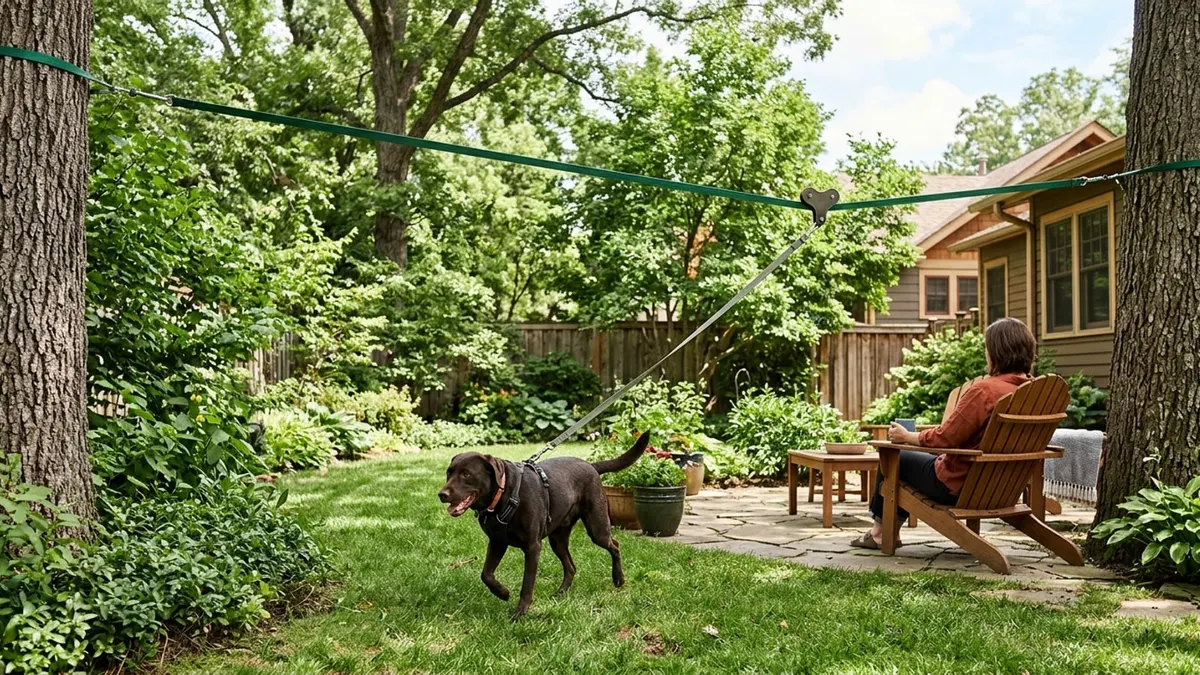
For supervised yard time, the runner cable to start with is the Snagle Paw 50 foot trolley: a vinyl-coated overhead cable with a turnbuckle to take up sag, a 10 foot lead that rides it on a pulley, and a shock spring on the lead where the dog's pull arrives. Check your state and city first. Twenty-three states and the District of Columbia have tethering laws, and they cap hours, bar certain collars and stop tethering in extreme weather. A trolley is still a tether. It suits a dog you can see from the house for an hour, not a dog left on it for the day.
Our top picks at a glance
- Snagle Paw 50 ft dog runner with 10 ft pulley lead
Overhead cable: 50 ft, vinyl coated · Lead: 10 ft pulley lead · Shock spring: On the lead · Dog weight (maker): Up to 250 lb
- Snagle Paw 75 ft heavy duty dog runner
Overhead cable: 75 ft, vinyl coated · Lead: Two 10 ft pulley leads · Shock spring: Yes · Dog weight (maker): Up to 250 lb
- XiaZ 100 ft trolley runner cable
Overhead cable: 100 ft, 5 mm stainless wire rope · Lead: 8 ft nylon bungee, two handles · Shock spring: Bungee lead · Dog weight (maker): Up to 250 lb; 5 kN pull (maker)
- CJYMMFAN 50 ft dog runner trolley
Overhead cable: 50 ft, 5 mm stainless, adjustable · Lead: 10 ft and 15 ft · Shock spring: Yes · Dog weight (maker): Up to 250 lb
| Pick | Overhead cable | Lead | Shock spring | Dog weight (maker) | Buy |
|---|---|---|---|---|---|
| Snagle Paw 50 ft dog runner with 10 ft pulley leadBest overall | 50 ft, vinyl coated | 10 ft pulley lead | On the lead | Up to 250 lb | Amazon |
| Snagle Paw 75 ft heavy duty dog runnerBest for two dogs | 75 ft, vinyl coated | Two 10 ft pulley leads | Yes | Up to 250 lb | Amazon |
| XiaZ 100 ft trolley runner cableLongest span | 100 ft, 5 mm stainless wire rope | 8 ft nylon bungee, two handles | Bungee lead | Up to 250 lb; 5 kN pull (maker) | Amazon |
| CJYMMFAN 50 ft dog runner trolleyBest adjustable | 50 ft, 5 mm stainless, adjustable | 10 ft and 15 ft | Yes | Up to 250 lb | Amazon |
A 50 foot vinyl-coated overhead cable with a turnbuckle and a 10 foot pulley lead with a shock spring.
- Overhead cable
- 50 ft, vinyl coated
- Lead
- 10 ft pulley lead
- Shock spring
- On the lead
- Dog weight (maker)
- Up to 250 lb
Pros
- Turnbuckle keeps the cable taut
- Spring sits on the lead, nearest the dog
- 1-year warranty
Cons
- Cable diameter not stated
- 250 lb is the maker's figure, with no test named
Snagle Paw lists an aerial trolley with a 50 foot cable and a 10 foot runner line, both vinyl covered against rain and rust, for dogs up to 250 lb by the maker's figure. A turnbuckle is included to take out sag so the pulley runs smoothly.
The shock-absorbing spring is on the lead, not on the overhead cable, which the maker says reduces the tension more directly. The clips are aluminum, turn through 360 degrees and screw shut.
The kit is described as complete for one person to install, with instructions, and carries a 1-year warranty. The bullets do not give the cable's diameter or a tested breaking strength.
Best for two dogs
Snagle Paw 75 ft heavy duty dog runner
A 75 foot overhead cable with two 10 foot leads, each with a shock spring.
- Overhead cable
- 75 ft, vinyl coated
- Lead
- Two 10 ft pulley leads
- Shock spring
- Yes
- Dog weight (maker)
- Up to 250 lb
Pros
- Two leads in the kit
- Longest Snagle Paw span
- Swivel locking clips
Cons
- Two dogs on one cable can tangle each other
- Warranty not stated in the bullets
This is the larger Snagle Paw kit: a 75 foot vinyl-coated cable and two 10 foot runner lines, which the maker says suits one or two dogs up to 250 lb.
Each line has a shock-absorbing spring, and the clips are aircraft aluminum with a swivel and a lock so they do not work loose as the dog moves.
Two leads on one cable means two pulleys that cannot pass each other, and two dogs whose lines can cross. That is our reading of the layout. Several state laws require a tether to let a dog reach water and shelter without becoming entangled, so place the stops and the shelter with both dogs in mind.
Longest span
XiaZ 100 ft trolley runner cable
A 100 foot, 5 mm stainless wire rope with tree slings and an 8 foot nylon bungee lead.
- Overhead cable
- 100 ft, 5 mm stainless wire rope
- Lead
- 8 ft nylon bungee, two handles
- Shock spring
- Bungee lead
- Dog weight (maker)
- Up to 250 lb; 5 kN pull (maker)
Pros
- States its wire: 5 mm, 5 kN
- Slings install between trees without screws
- Longest run here
Cons
- Nylon lead can be chewed
- A long span sags without good tension
XiaZ lists a 100 foot overhead cable of stainless steel wire rope 5 mm in diameter, which the maker says withstood a pull of up to 5 kN in a tensile test. It is the only listing here that gives both a diameter and a test figure.
It installs two ways: with cable slings around trees, which the maker says avoids damaging them, or with screw hooks. The lead is an 8 foot nylon bungee with two handles, so its length can be chosen, and the stretch is there to soften a sudden stop.
The maker's own argument for a trolley over a ground stake is that it reduces the chance of a dog getting wrapped around trees, posts or chairs. A nylon lead is lighter than cable and easier to chew through; check it each time.
Best adjustable
CJYMMFAN 50 ft dog runner trolley
A 50 foot, 5 mm stainless cable whose length adjusts, with 10 and 15 foot leads and a shock spring.
- Overhead cable
- 50 ft, 5 mm stainless, adjustable
- Lead
- 10 ft and 15 ft
- Shock spring
- Yes
- Dog weight (maker)
- Up to 250 lb
Pros
- Overhead line shortens for a small yard
- Two lead lengths
- Storage bag and wrench included
Cons
- Screw hooks need a sound tree, post or wall
- Warranty not stated
CJYMMFAN lists a 50 foot overhead line of 5 mm stainless steel wire, which the maker says resists chewing and rust, for large dogs up to 250 lb. The line's length adjusts, to fit a smaller yard.
Two leads are included, 10 and 15 feet, with a shock-absorbing spring and a zinc alloy clip that swivels through 360 degrees and locks. The screw hooks are described as 15 percent larger and thicker than before.
It fixes with the included L-wrench to trees, patio posts, walls or a house frame, and packs into a storage bag. What it screws into matters as much as the hook: a dog at the end of a 15 foot lead puts a sideways load on that anchor every time it runs.
How we chose
We read the makers' Amazon listings on November 18, 2026 and compared the overhead cable, the lead, the shock absorber and the dog weight each maker states. Every kit claims 250 lb. Only one names a test, so we give more weight to stated wire diameter. A listing cannot show how an anchor holds in your tree or wall, and we make no claim about that.
| Kit | Overhead cable | Leads | Wire stated | Warranty |
|---|---|---|---|---|
| Snagle Paw 50 ft | 50 ft, vinyl coated | One, 10 ft | No | 1 year |
| Snagle Paw 75 ft | 75 ft, vinyl coated | Two, 10 ft | No | Not stated |
| XiaZ | 100 ft | One, 8 ft bungee | 5 mm stainless, 5 kN | Not stated |
| CJYMMFAN | 50 ft, adjustable | 10 ft and 15 ft | 5 mm stainless | Not stated |
The law comes first
The Animal Legal and Historical Center at Michigan State University counts 23 states and the District of Columbia with laws on tethering dogs. They differ, and a trolley is covered by most of them.
- Hours. Nevada allows no more than 14 hours in 24, Massachusetts 5. Oregon allows 10 on a fixed tether and 15 where the tether is attached to a running line, pulley or trolley.
- Presence. Delaware limits tethering to 2 hours when no owner or responsible person is on the property. California bars tethering to a stationary object except for the time needed to finish a temporary task.
- Collars. Hawaii, Rhode Island and several other states outlaw choke, pinch or prong collars on a tethered dog.
- The tether. Indiana, Michigan and Pennsylvania require one at least three times the dog's length. Many states require that it let the dog reach food, water and shelter without becoming entangled.
- Weather. Pennsylvania presumes neglect when a dog is tethered for more than 30 minutes above 90 F or below 32 F. Connecticut and Massachusetts allow 15 minutes during a weather advisory.
States without a tether law still have cruelty laws, and many cities and counties have their own rules. Look yours up before you drill a hook.
Trolley or ground stake
A trolley keeps the line overhead, so there is less of it on the ground to wrap around legs and furniture. XiaZ makes that argument in its listing, and CJYMMFAN says a trolley removes obstacles on the ground that a stake leaves. Oregon's law draws the same line, allowing five more hours on a running line than on a fixed tether. A tie-out stake is the portable choice for a campsite. A fenced run or kennel needs no tether at all.
Setting one up
- Fix the overhead cable above head height between two sound anchors, and tension it; Snagle Paw includes a turnbuckle for the purpose.
- Set the stops so the dog cannot reach a fence it could jump, a drop, or anything it could wind the lead around.
- Make sure the dog can reach shade, water and shelter from every point of the run.
- Clip the lead to a harness or a flat collar, never a choke, pinch or prong collar.
- Walk the whole run with the dog on the lead before you let go.
While the dog is on it
Stay within sight. AVMA does not recommend leaving any pet outside for long periods, and the federal rules for licensed kennels prohibit permanent tethering as a way of housing a dog. Bring the dog in when the weather turns. AKC notes that most tethering laws forbid it below 32 F, during extreme heat advisories and under storm warnings. Check the clips, spring and lead for wear every time. A tether fails at its weakest part, and that is seldom the cable.
Frequently asked questions
Are dog runner cables legal?
It depends where you live. Twenty-three states and the District of Columbia have tethering laws, which limit hours, collar types and weather, and many cities add their own. Oregon allows up to 15 hours in 24 on a running line or trolley; Massachusetts allows 5 hours on any tether.
Is a trolley better than a tie-out stake?
A trolley keeps the line overhead, so there is less to tangle; makers say so, and Oregon's law allows longer on a running line than on a fixed tether. A stake is portable. Neither replaces a fence for a dog left alone.
How long can I leave my dog on a runner?
As short as you can, and never out of sight. State limits range from 5 to 14 hours in a day, with shorter limits in bad weather. AVMA does not recommend leaving any pet outside for long periods.
What collar should I use with a runner cable?
A harness or a flat collar. Several states outlaw choke, pinch or prong collars on a tethered dog, and a shock spring or bungee softens a sudden stop.
How high should a dog trolley cable be?
Above head height, so people can walk under it and the lead hangs down to the dog. The listings do not give a figure. Tension the cable so it does not sag; Snagle Paw includes a turnbuckle.
Can two dogs share one runner cable?
Snagle Paw sells a 75 foot kit with two leads for that. The pulleys cannot pass each other and the leads can cross, so place the stops with both dogs in mind and watch them.
Sources
- Table of State Dog Tether Laws, Animal Legal & Historical Center, Michigan State University College of Law
- 9 CFR 3.6: Primary enclosures, Legal Information Institute, Cornell Law School
- Cold weather animal safety, American Veterinary Medical Association
- How Long Can You Keep Your Dog Outside?, American Kennel Club
Cover image: Illustration: Dog Kennel Review (AI-generated)
Related guides
Dog Run Fence Calculator: Panels, Gates and Area for Your Run
How many panels a rectangular run takes, and how big it really comes out.
Dog Tie-Out Stakes: Spiral and Swivel Stakes for Camping and the Yard (2026)
Stakes that hold in sand, clay and rock, and how to use them safely.
How to Set Up a Dog Run: Site, Base, Fencing, Shade and Water
From picking the spot to the first clean-out.