
Outdoor Kennel vs Dog Run: Which Setup Suits Your Dog and Yard
Outdoor dog kennel vs dog run: walk-in kennels, long fenced runs and overhead trolley runners compared on space, security, shelter and the law, and when to use each.
Affiliate disclosure: product links on this page go to Amazon or to the maker's own store. As an Amazon Associate we earn from qualifying purchases, at no extra cost to you; links to makers' own stores earn us nothing. No retailer or brand sees our picks before they are published or has any say in them. How we choose.
A kennel is a roofed pen a dog rests in. A run is a long fenced strip a dog moves in. A trolley runner is a tether on an overhead cable, and it is the only one of the three that tethering laws apply to. For a dog that will be outside without you beside it, choose a fence: a kennel if the dog mostly waits, a run if it needs to trot. Whichever you choose, the same things have to be inside it or within reach: shade, water, a shelter and your company. The federal rules for licensed kennels, AVMA and MSD's veterinary manual agree on that list.
Side by side
| Walk-in kennel | Fenced run | Trolley runner | |
|---|---|---|---|
| What it is | A square or near-square pen, usually roofed | A long, narrow fenced strip | An overhead cable with a lead on a pulley |
| Typical size | 8 x 4 to 10 x 14 ft | 5 x 15 ft and longer | 50 to 100 ft of cable |
| Holds the dog by | Fence, roof and a locking door | Fence and a gate | A tether |
| Keeps other animals out | Yes, if roofed | Partly | No |
| Shade | Roof cover | Needs a cover or trees | Only what the yard offers |
| Tether laws apply | No | No | Yes, in 23 states and D.C. |
| Examples | MAXSA 10 x 10, Maison Backyards 10 x 14 | Lucky Dog built as 5 x 15 | Snagle Paw 50 ft |
What a kennel does best
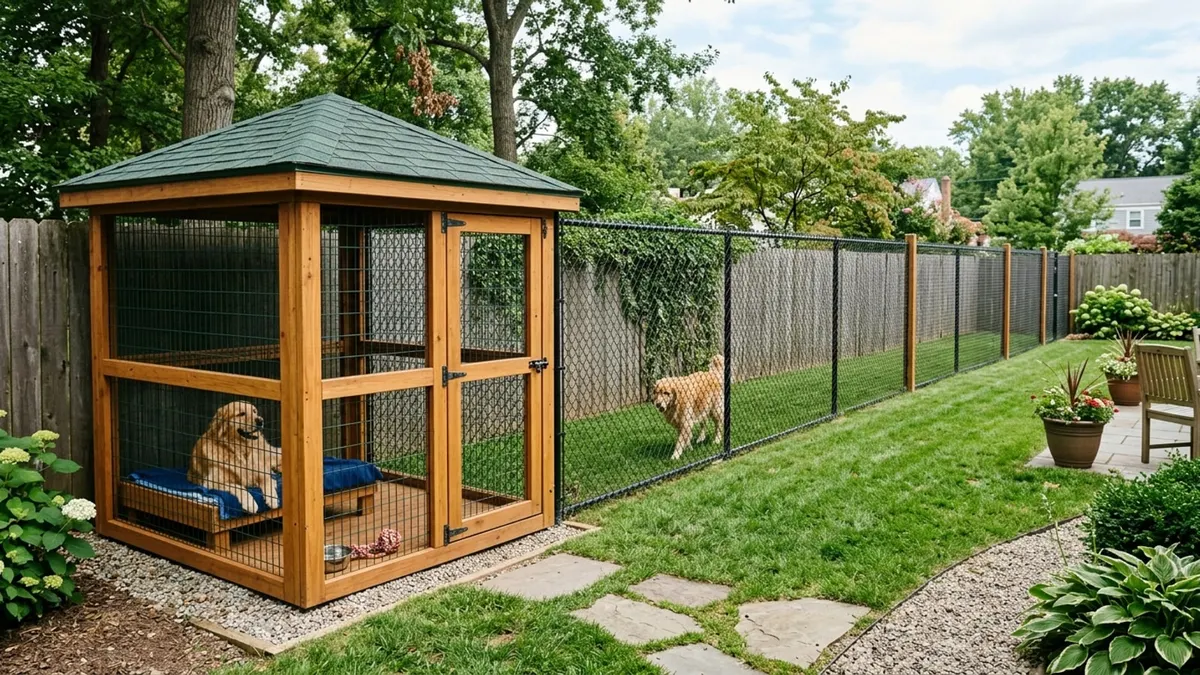
A kennel contains. The federal rules for licensed kennels ask an enclosure to hold dogs securely and to keep other animals out, and a pen with a roof and a locking door does both. It also gives shade from the first day, since most kennels are sold with a roof cover. Kennels for yards are compared on our outdoor kennels page. Its limit is shape. A 10 by 10 foot square gives a dog room to stand, turn, lie down and walk a few steps, which is what the rules require, and not much of a gallop.
What a run does best
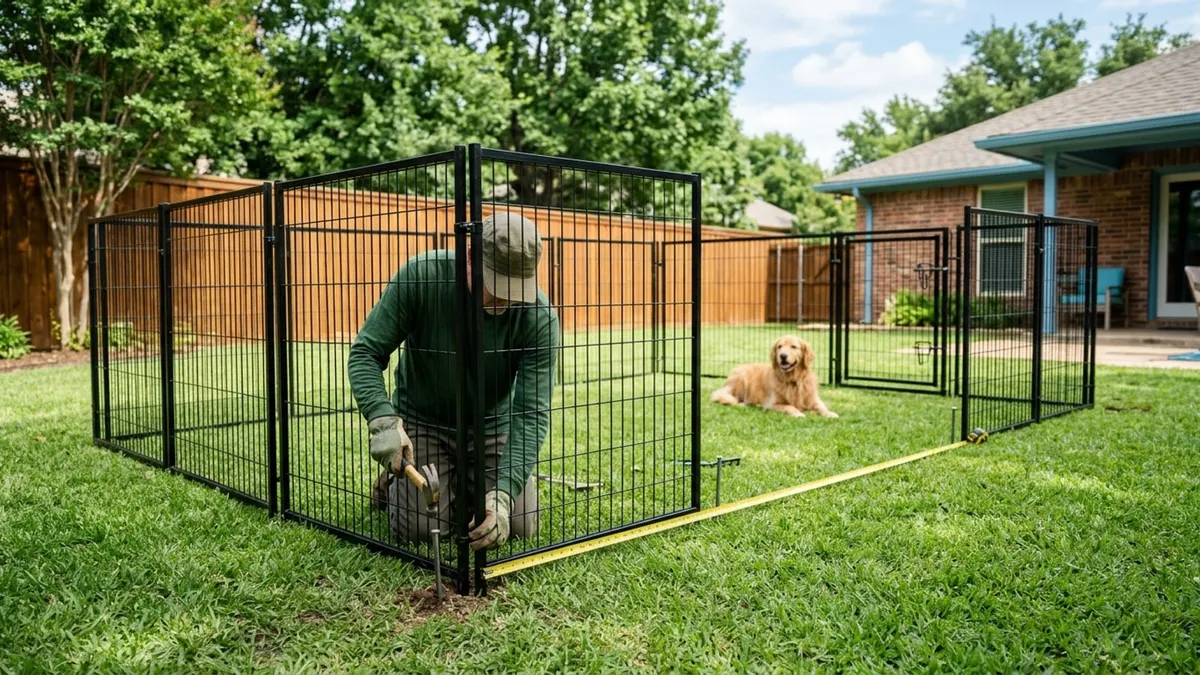
A run trades width for length so a dog can build up some speed. The same fence goes further that way: the Lucky Dog kit builds as 10 by 10 or as 5 by 15 from one set of panels, 40 feet of fence either way. The square encloses 100 square feet and the run 75. That is the cost of length, and for a dog that paces or chases a ball it is worth paying. Runs are usually sold or built without a roof, so shade and a shelter have to be added. Our guide to setting up a dog run goes through it.
What a trolley does, and its limits
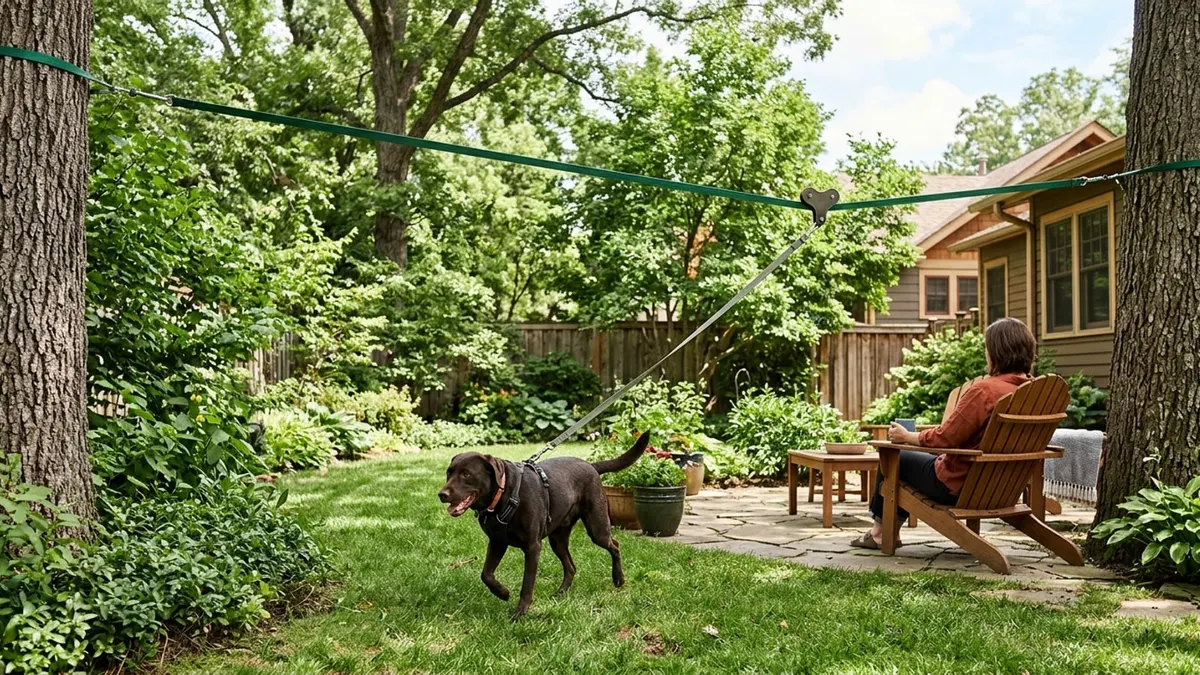
A trolley gives the most distance for the least money and needs no fence at all. A lead rides a pulley along a cable between two anchors, and the dog covers the whole length. It is a tether, and the law treats it as one. The Animal Legal and Historical Center counts 23 states and the District of Columbia with tethering laws: limits of 5 to 14 hours in a day, bans on certain collars, and short limits in extreme weather. Oregon is unusual in allowing a running line longer than a fixed tether, 15 hours against 10. A tether also protects nothing. It does not keep other dogs or wildlife away from yours, and the federal rules prohibit permanent tethering as a means of housing a dog in licensed facilities. Kits are compared on runner cables.
How much space each really gives
By the federal formula, a dog 36 inches long needs 12.25 square feet at the least and 24.5 before the space counts toward exercise. Any kennel or run sold for a yard clears that. Local rules can be far higher. AKC notes that some municipalities require upwards of 200 square feet of outdoor space per dog, which is more than a 10 by 10 kennel and close to a 10 by 20 run. The kennel space calculator and the fence calculator do the sums.
What all three need
- Shade and water. AVMA: unlimited fresh water, and shade whenever the dog is outside.
- A shelter. MSD's veterinary manual: clean, big enough to stand up and turn around in, with a solid roof and a floor off the ground.
- Limits on weather. AVMA says no pet should be left outside for long in below-freezing weather; ASPCA says to keep pets indoors when it is extremely hot.
- Company. MSD lists frequent human contact as a need of outdoor dogs, and AKC advises bringing dogs in before bedtime.
The sources' positions are set side by side in is it safe to keep a dog outside.
What each takes to put up
A kennel kit arrives as panels. MAXSA describes its assembly as tool-free, and Petony puts its small roofed pen at about an hour for two people. It then needs a level base and, for anything but a short stay, a dog house inside. A fenced run is the same panels in a line, plus more groundwork, because a long narrow strip of grass wears out faster than a square one. A trolley needs two anchors that will take a running dog's pull, a tree, a post or a wall, and a cable tensioned between them. Snagle Paw includes a turnbuckle, and XiaZ supplies slings so the cable can go round a tree without screws.
Two dogs
The federal rules for licensed kennels add each dog's space together and require dogs sharing an enclosure to be compatible. MSD's veterinary manual says dogs housed together need enough room for all of them, or separate shelters. A kennel or run handles two dogs if it is big enough and has two places to lie down. A single trolley with two leads does it less well: the pulleys cannot pass each other, and the lines cross.
How to choose
- The dog waits outside while you are at work or busy: a roofed kennel with a dog house inside.
- The dog needs to move: a run, as long as the yard allows, with shade at one end.
- You rent, camp, or cannot fence: a trolley or a playpen, used while you are there, within your state's tethering law.
- The dog escapes: a heavy duty kennel with a roof, and more exercise.
Frequently asked questions
What is the difference between a dog kennel and a dog run?
A kennel is a square or near-square pen, usually roofed, for resting. A run is a long, narrow fenced strip for moving. Some kits build either way: Lucky Dog's makes a 10 by 10 kennel or a 5 by 15 run from the same panels.
Is a dog run better than a kennel?
For exercise, a run's length lets a dog get up some speed. For security and shade, a roofed kennel does more. The same 40 feet of fence encloses 100 square feet as a square and 75 as a 5 by 15 run.
Is a trolley runner a dog run?
No. It is a tether on an overhead cable. Tethering laws in 23 states and the District of Columbia apply to it, limiting hours, collars and use in extreme weather, and it does nothing to keep other animals away from the dog.
How big should a dog run be?
As long as the yard allows. The federal minimum for a 36 inch dog in a licensed kennel is 12.25 square feet, a figure any run clears; AKC notes some municipalities require upwards of 200 square feet per dog.
Does a dog run need a roof?
It needs shade over part of it. The federal rules for licensed kennels require enough shade for every dog at once, and AVMA says dogs outside need access to shade. A shelter with a roof, sides and a floor is a separate need.
Can a dog stay in a kennel or run all day?
AVMA does not recommend keeping any pet outside for long periods, and AKC advises bringing dogs in before bedtime. With shade, water, a shelter and mild weather, part of a day is reasonable; all day every day is not.
Sources
- 9 CFR 3.6: Primary enclosures, Legal Information Institute, Cornell Law School
- 9 CFR 3.8: Exercise for dogs, Legal Information Institute, Cornell Law School
- Table of State Dog Tether Laws, Animal Legal & Historical Center, Michigan State University College of Law
- How Long Can You Keep Your Dog Outside?, American Kennel Club
- Cold weather animal safety, American Veterinary Medical Association
- Warm weather pet safety, American Veterinary Medical Association
- Table: Special Needs of Outdoor Dogs, MSD Veterinary Manual
- Hot Weather Safety Tips, ASPCA
Cover image: Illustration: Dog Kennel Review (AI-generated)
Related guides
Dog Run Fence Calculator: Panels, Gates and Area for Your Run
How many panels a rectangular run takes, and how big it really comes out.
Dog Runner Cables: Overhead Trolley Systems for Supervised Yard Time (2026)
Overhead trolleys that give room to roam with fewer tangles than a stake.
Dog Tie-Out Stakes: Spiral and Swivel Stakes for Camping and the Yard (2026)
Stakes that hold in sand, clay and rock, and how to use them safely.