
Dog House Heaters: Should You Heat a Dog House? (2026)
Should you put a dog house heater in a dog's shelter? AVMA says to avoid space heaters and heat lamps. What to do first, and heated pads to use with caution.
Affiliate disclosure: product links on this page go to Amazon or to the maker's own store. As an Amazon Associate we earn from qualifying purchases, at no extra cost to you; links to makers' own stores earn us nothing. No retailer or brand sees our picks before they are published or has any say in them. How we choose.
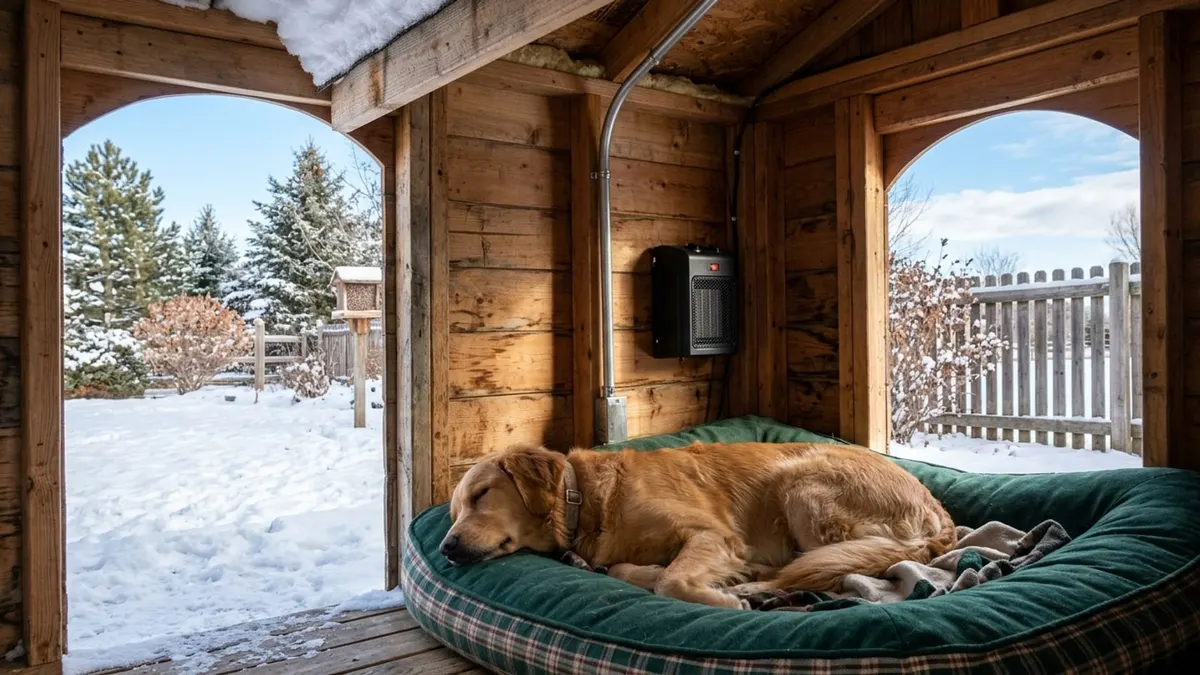
For most dog houses the answer is no heater. The American Veterinary Medical Association tells owners to avoid space heaters and heat lamps in a dog's shelter, naming burns and fire as the risk, and the wall-mounted heaters sold for dog houses are small space heaters of 300 to 800 watts. What AVMA asks for is a solid shelter out of the wind, a floor off the ground and thick, dry bedding, with the dog indoors in freezing weather.
If the house already has all of that and you want to add warmth, the form of heat AVMA allows, with caution, is a heated mat. The one we would start with is the K&H Lectro-Kennel: a rigid 80 watt pad with a steel-wrapped cord and a fleece cover. This guide sets out the advice, the steps that come before heat, where a pad fits, and what the heater listings say.
What AVMA says about a dog house heater
AVMA's page on cold weather gives heating a dog's shelter two sentences. The first says space heaters and heat lamps should be avoided, and gives the risk of burns or fire as the reason. The second says heated pet mats should be used with caution, because a mat can still cause burns.
A dog house heater is a space heater. It mounts on the wall of the house, plugs into an outlet and heats the air, in some models with a fan. So the advice covers it, and nothing in the makers' listings changes that.
The same passage opens by saying AVMA does not recommend keeping any pet outside for long periods of time. Further down the page it says no pet should be left out for long in below-freezing weather. Heat in the house does not move that limit.
What to do before any dog house heater
The sources agree on what makes a dog house warm, and none of the steps uses a heater. They come from AVMA, from Humane World for Animals and from the federal rule for licensed kennels, 9 CFR 3.4. That rule is a legal floor for businesses, not a target for a pet, but it puts numbers on bedding.
| Step | What the source says | Source |
|---|---|---|
| Solid walls and roof | A warm, solid shelter against wind; a roof, four sides and a floor | AVMA; 9 CFR 3.4 |
| Raised floor | Off the ground, to cut heat loss into it; raised a few inches | AVMA; Humane World |
| Bedding | Thick, dry and changed regularly; straw or cedar shavings; required below 50 F in licensed kennels, with more at 35 F or lower | AVMA; Humane World; 9 CFR 3.4 |
| Doorway | Turned away from the prevailing wind; covered with heavy plastic or waterproof burlap; a wind break and rain break | AVMA; Humane World; 9 CFR 3.4 |
| Size | Large enough to move in comfortably, small enough to hold in body heat | Humane World |
| Water | Fresh and not frozen, by changing it often or with a heated bowl made for pets | AVMA |
How to do each step is in how to winterize a dog house. Houses sold with insulated walls and raised floors are on insulated dog houses, covers for the doorway on dog house door flaps, and bowls that keep water liquid on heated dog water bowls. Do these first: they are what all three sources ask for, and not one of the three lists a heater.
Where a heated pad fits
A heated pad is the one kind of added heat that AVMA does not tell owners to avoid. Its word is caution. A pad warms the dog where the dog lies on it, through a cover, and does not heat the air in the house.
The K&H Lectro-Kennel in the large size is a rigid ABS pad of 28.5 by 22.5 inches that draws 80 watts, with a 5.5 foot steel-wrapped cord and a removable fleece cover, all per its listing. K&H says the pad warms to its full temperature only when a pet is lying on it, and describes the whole product as safety listed. The pad does not flex, so measure the floor of the house before ordering.
Where a soft bed suits the dog better, the K&H Lectro-Soft is a 36 by 25 inch heated bed on a foam base that the maker calls orthopedic, drawing 60 watts. Its thermostat warms the surface to the pet's normal body temperature, and only while the pet is on it. K&H says it is for sheds, garages, barns and other sheltered places, and is not for pets that chew.
Three habits follow from AVMA's caution; they are our reading of it, not AVMA's list. Keep the maker's cover on the pad. Leave part of the floor unheated, because AVMA advises giving pets a choice of sleeping places so they can adjust to their need for warmth. Take the cord out through the back wall and not the doorway. All four pads we compared, with sizes and warranties, are on heated dog pads.
What the dog house heater listings say
Four heaters sold for dog houses were read on Amazon on November 18, 2026. We do not recommend any of them and do not link to them. The table is here because people look for a dog house heater and should be able to see what the listings claim and what they leave out.
| Heater | Watts | Temperature control | Cord | Safety claims in the listing |
|---|---|---|---|---|
| Akoma Hound Heater | 400 | Adjustable thermostat | 10 ft, described as chew-proof | Internal heat shield, rounded corners; no certification named |
| Ficuswin | 600 | 70 to 120 F, with a 24-hour timer | 78 in, chew resistant | Overheat shutoff; "ETL certified", no file number |
| TURBRO Neighborhood | 400 or 800 | Phone app and a controller outside the house | 9.8 ft, chew resistant | Overheat protection; "passed UL test", no file number |
| Dreyoo | 300 or 600 | Fixed: off above 78.8 F, on below 68 F | 6 ft, steel wrapped | Overheat protection; "ROHS and UL certification", no file number |
The features answer the two risks AVMA names: heat shields, insulated cases and overheat cut-outs against burns and fire, and armored cords against chewing. None of the three certification claims comes with a file number a buyer could look up, and the Akoma listing names no certification at all. The US Consumer Product Safety Commission's recall list, searched on November 18, 2026, shows no recall of these four heaters. It does hold two recalls of other heated pet products, in 2010 and 2012, both for fire or shock hazards.
The heaters are also large for the job. Akoma rates its heater for up to 100 cubic feet and TURBRO for up to 150. Inside length times width times height in inches, divided by 1,728, gives cubic feet: a dog house of 60 by 36 by 35 inches holds about 44, and one of 33.5 by 22 by 25 inches about 11. That is our arithmetic, and it means the smallest heater in the table is rated for more than twice the air in a big dog house.
If you already use a dog house heater
A dog house heater that is already on the wall can be run with more care, though not with AVMA's approval. These points come from the listings and from ordinary electrical and fire practice; they are ours, not AVMA's.
- Use it only in an enclosed house. The listings rate their heaters for an enclosed shelter or for a set volume of air.
- Mount it above the dog. Dreyoo's instructions say to find a position taller than the pet.
- Keep straw, shavings and blankets clear of it.
- Use the lowest setting. Ficuswin's thermostat can be set as high as 120 F.
- Take the cord out through the wall, not the doorway, and plug it into an outdoor outlet with ground-fault protection.
- Check it every day for hair, dust and chewing, and watch the dog. AVMA's signs of heat stress are anxiousness, excessive panting, restlessness, excessive drooling, unsteadiness, abnormal gum and tongue color, and collapse, and it says to seek emergency veterinary care for any of them.
When heating the dog house is not the answer
Heating the dog house does not replace bringing the dog in. AVMA says cats and dogs should be kept inside during cold weather, and that even long-haired and thick-coated breeds should not be left out for long below freezing. It adds that very young and very old pets, and pets with diabetes, heart disease, kidney disease or hormonal imbalances, may have a harder time regulating their body temperature.
Know the signs of a dog that is too cold. AVMA lists whining, shivering, seeming anxious, slowing down or stopping, seeming weak and looking for warm places to burrow as signs of hypothermia, and says to get the pet back inside quickly. More on those limits is in is it safe to keep a dog outside.
Frequently asked questions
Should you put a heater in a dog house?
AVMA's advice is no. Its cold-weather page says space heaters and heat lamps should be avoided in a dog's shelter because of the risk of burns or fire. It asks for a solid shelter out of the wind, a floor off the ground and thick, dry bedding, and says heated pet mats may be used with caution.
Are dog house heaters a fire risk?
AVMA names burns and fire as its reasons for avoiding space heaters in a dog's shelter. The four heater listings we read describe heat shields, overheat cut-outs and chew-resistant cords, and three claim ETL or UL certification without giving a file number. Those features lower the risk. They do not change AVMA's advice.
What can I use instead of a dog house heater?
Start with the house: a raised floor, thick dry bedding of straw or cedar shavings, a covered doorway turned away from the wind, and a size small enough to hold in body heat. If you still want added warmth, AVMA allows a heated pet mat, with caution. The K&H Lectro-Kennel is an 80 watt rigid pad with a steel-wrapped cord and a fleece cover.
Can I use a heat lamp in a dog house?
AVMA says heat lamps should be avoided in a dog's shelter, for the same reason as space heaters: the risk of burns or fire.
Is a heated pad better than a dog house heater?
By AVMA's wording, yes. Heaters are to be avoided, while heated pet mats are to be used with caution because they can still cause burns. Keep the maker's cover on the pad and leave part of the floor unheated so the dog can move off it.
How many watts is a dog house heater?
The four listings we read run from 300 to 800 watts: Dreyoo 300 or 600, Akoma 400, Ficuswin 600 and TURBRO 400 or 800. For comparison, the K&H Lectro-Kennel heated pad draws 80 watts and the K&H Lectro-Soft heated bed 60.
Do I need a heater if the dog house is insulated?
Often not, going by the sources' own lists. AVMA's cold-weather shelter is solid, out of the wind, raised off the ground and thickly bedded, with water that is not frozen and no heater. Whatever the house has, AVMA says no pet should be left outside for long periods in below-freezing weather.
Sources
- Cold weather animal safety, American Veterinary Medical Association
- Warm weather pet safety, American Veterinary Medical Association
- How to Keep Pets Warm in Cold Weather, Humane World for Animals
- 9 CFR 3.4: Outdoor housing facilities, Legal Information Institute, Cornell Law School
- Recalls & Product Safety Warnings, US Consumer Product Safety Commission
Cover image: Illustration: Dog Kennel Review (AI-generated)
Related guides
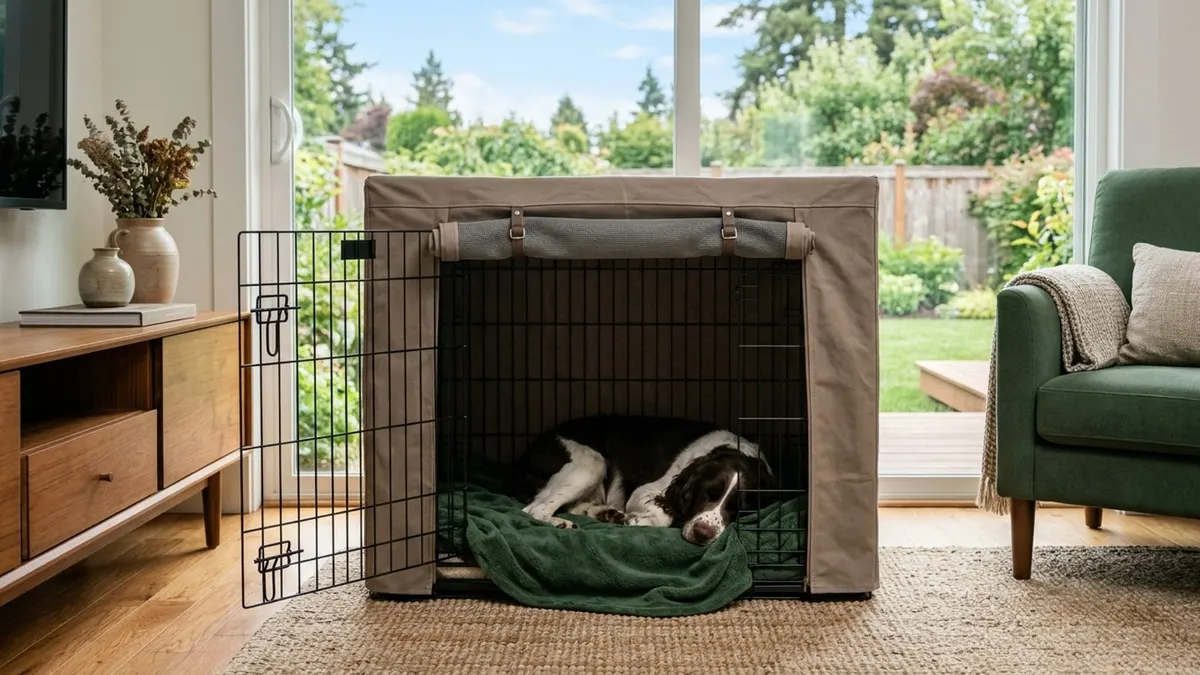
Dog Crate Covers: Calmer, Darker Crates for Home and Travel (2026)
Covers that make a wire crate den-like without blocking airflow.
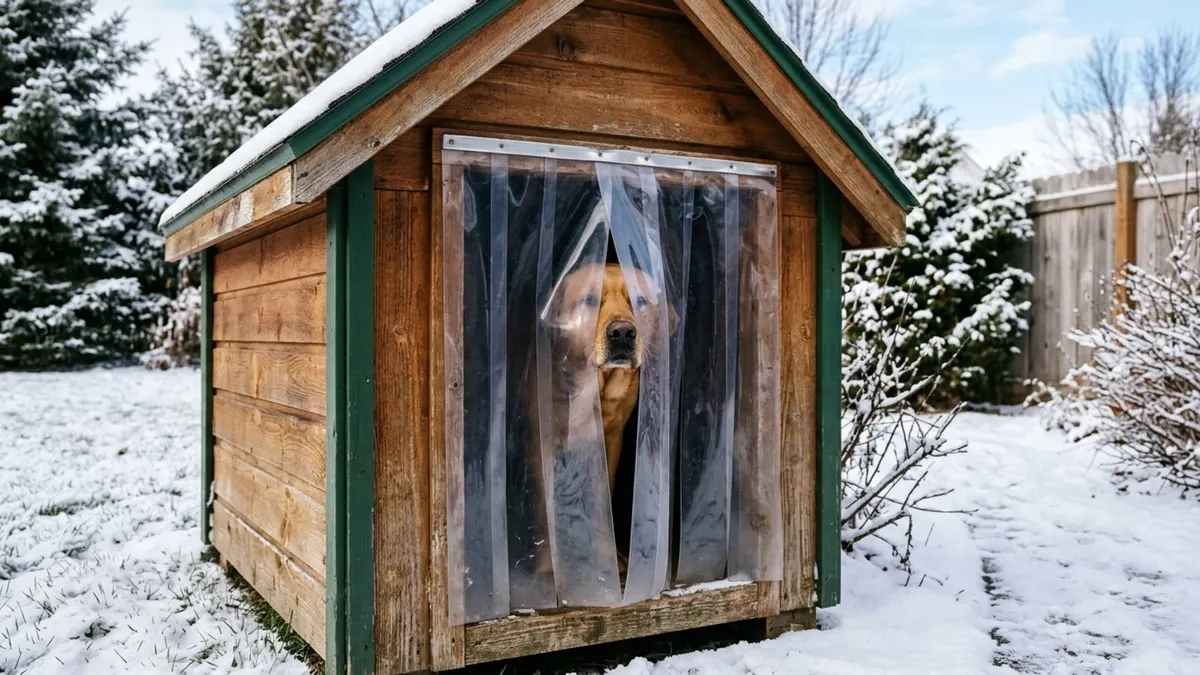
Dog House Door Flaps: Block Wind and Rain at the Doorway (2026)
Flaps that keep wind and snow off the bed.
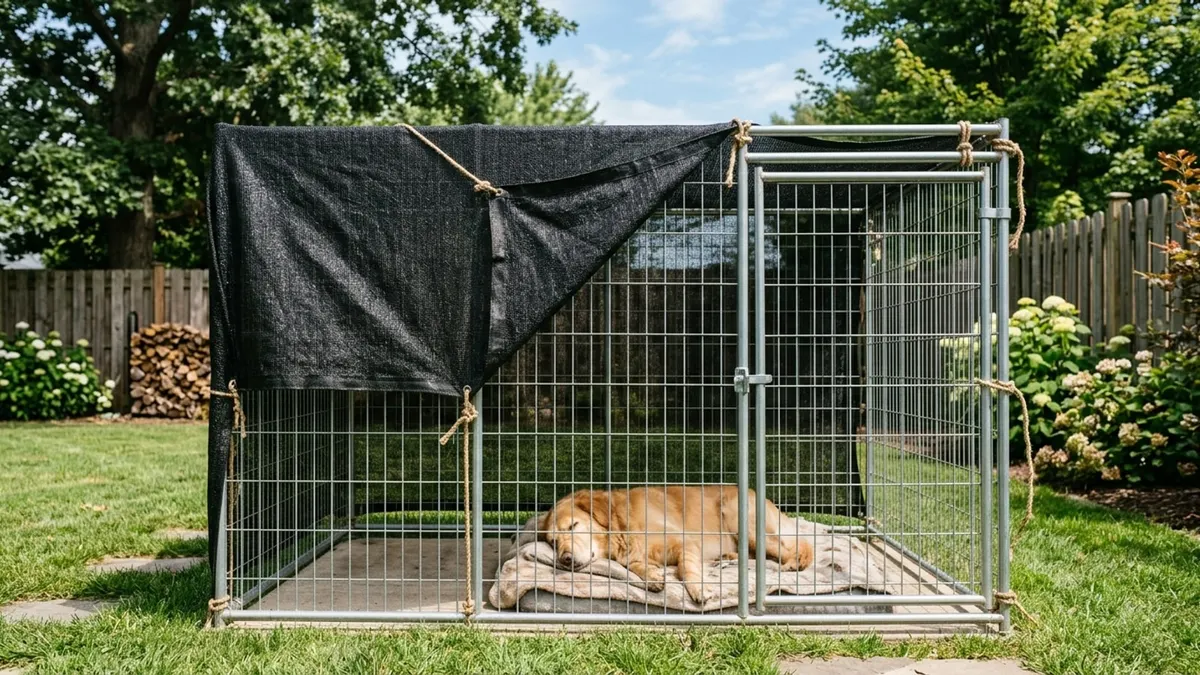
Dog Kennel Shade Covers: 90 to 95 Percent Shade Cloth for Runs (2026)
Breathable shade cloth that cools a kennel without trapping heat.