
How to Winterize a Dog House: Size, Floor, Door, Bedding, Water
How to winterize a dog house: right-size it, raise the floor, turn the door from the wind and cover it, keep bedding dry and water unfrozen, per AVMA and MSD.
Affiliate disclosure: product links on this page go to Amazon or to the maker's own store. As an Amazon Associate we earn from qualifying purchases, at no extra cost to you; links to makers' own stores earn us nothing. No retailer or brand sees our picks before they are published or has any say in them. How we choose.
Raise the house off the ground, turn its door away from the prevailing wind and cover it with a flap, fill it with thick, dry bedding, and make sure the water outside it cannot freeze. That is the American Veterinary Medical Association's list, and MSD's veterinary manual, Humane World for Animals and the federal rules for licensed kennels each repeat most of it. Heat is not on the list. AVMA says to avoid space heaters and heat lamps in a dog's shelter. And the first question is not about the house at all: it is whether this dog should be outside in this weather.
Before you start: should the dog be out?
AVMA does not recommend keeping any pet outside for long periods, and says no pet should be left outside for long in below-freezing weather. ASPCA's rule of thumb is that if it is too cold for you, it is probably too cold for your pet. Some dogs should not winter outdoors whatever the house. The federal rules for licensed kennels name them: dogs not acclimated to the local temperatures, breeds that cannot tolerate them, such as short-haired breeds in cold climates, and the sick, infirm, aged and young. AKC adds small dogs and puppies. The full picture is in is it safe to keep a dog outside.
Nine steps
- Check the size. Large enough to move comfortably, small enough to hold in body heat, says Humane World. A house that is too big cannot be bedded into a warm one: see the size guide.
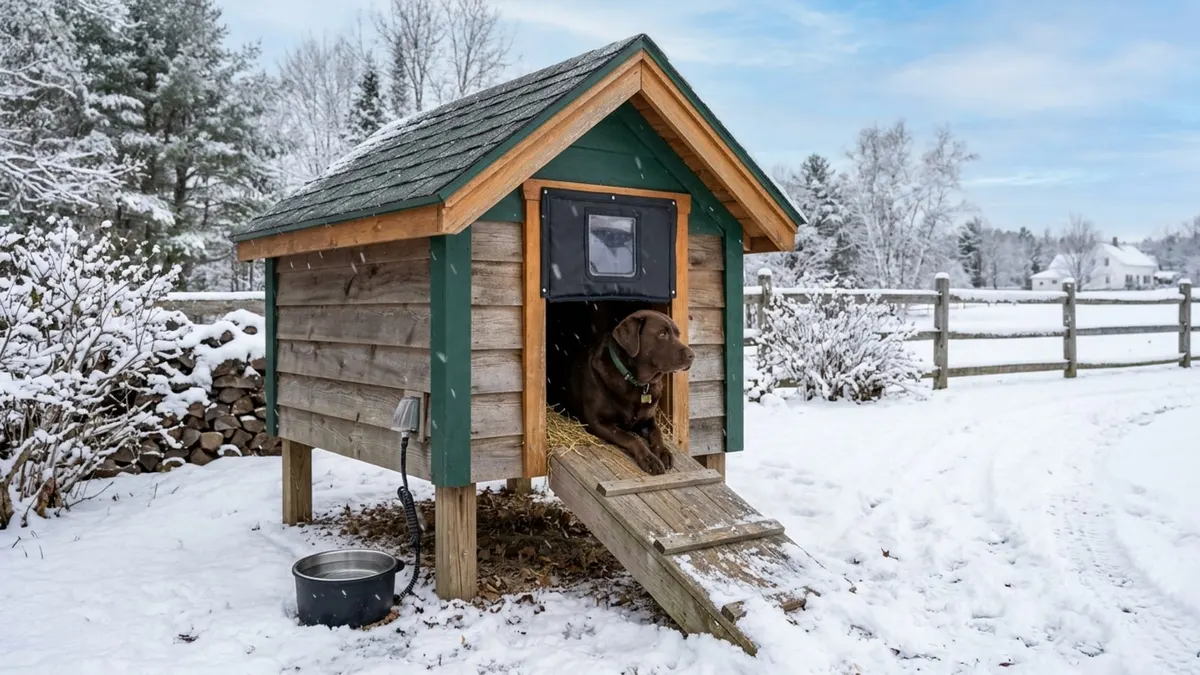
- Raise the floor. AVMA says the floor should be off the ground to minimize heat loss into it. Humane World says a few inches. Blocks or a pallet do it for a house that sits flat.
- Turn the door. AVMA: position it away from the prevailing winds. A wall, hedge or fence on the windward side helps as well.
- Cover the door. MSD says flexible doors keep rain and snow out; Humane World says waterproof burlap or heavy plastic. See door flaps.
- Stop the drafts. Humane World asks for a dry, draft-free shelter. Close gaps between panels; leave any vent the maker put at the top.
- Bed it deep. Straw or cedar shavings, says Humane World. Thick, dry and changed regularly, says AVMA.
- Water. Unlimited, fresh and not frozen, says AVMA, by changing it often or with a heated bowl. Use plastic: Humane World warns that a tongue can freeze to metal.
- Food. MSD's veterinary manual says outdoor dogs need twice as many calories in cold weather, fed in smaller meals. AVMA says to talk to your veterinarian about the amount.
- Look in every day. Feel the bedding. If it is damp, change it.
How much bedding, and when
The only figures are in the federal rules for licensed kennels: clean, dry bedding in the shelter when the temperature is below 50 F, and additional bedding at 35 F or lower. Fifty degrees is earlier in the autumn than most owners start. Put the bedding in when nights reach it, and double it before the first frost. The sources name straw and shavings, not blankets or towels. We would follow them; fabric that gets wet stays wet.
Common mistakes
- Trusting the coat. AVMA calls it a common belief that dogs resist cold better than people because of their fur, and says it is untrue.
- A house that is too big. The dog cannot warm the spare air.
- The door facing the weather. Turning the house costs nothing.
- A metal water bowl. Humane World for Animals warns that a tongue can stick and freeze to metal.
- Bedding left damp. Wet bedding takes heat from the dog. AVMA's word is dry.
- A wet coat or sweater. AVMA says a wet sweater can make a dog colder, and AKC that a damp dog is more open to frostbite.
- A heat lamp. AVMA says to avoid them.
About heat
AVMA: space heaters and heat lamps should be avoided because of the risk of burns or fire, and heated pet mats should be used with caution because they are still capable of causing burns. If the first nine steps are done and the dog is still cold, the choice is between bringing it in and a covered heated pad with a protected cord and room to lie off it. The reasoning is in insulated or heated.
Signs the dog is too cold
AVMA lists them: whining, shivering, seeming anxious, slowing down or stopping moving, seeming weak, and looking for warm places to burrow. They are signs of hypothermia, and they mean get the dog inside quickly. AKC adds what comes next if nothing is done: a heart rate that rises and then slows, breathing that becomes slow and shallow, sluggishness, pale gums, dilated pupils and loss of consciousness. Mild hypothermia starts when body temperature falls below 99 F. Frostbite is harder to see and may not show fully for days, AVMA says. Either one is a call to the veterinarian.
Bring the dog in when
- The temperature is below freezing for more than a short spell.
- A storm is coming. ASPCA's medical director says outdoor animals should be brought in and kept in until the storm and the cold pass.
- The dog is small, old, young, ill or short-coated. A veterinarian quoted by AKC keeps small dogs to 10 to 15 minutes below 32 F.
- Any sign from the list above appears.
A house that is insulated to begin with makes all of this easier: see insulated dog houses.
Frequently asked questions
How do I keep my outdoor dog warm in winter?
A right-sized house off the ground, its door away from the wind and covered, thick dry bedding of straw or shavings, unfrozen water and extra food. That is the list from AVMA, MSD's veterinary manual and Humane World for Animals. Bring the dog in below freezing.
What bedding should I use in a dog house in winter?
Humane World for Animals names straw or cedar shavings. AVMA says bedding should be thick, dry and changed regularly, and the federal rules for licensed kennels require it below 50 F with more at 35 F or lower.
Which way should a dog house door face in winter?
Away from the prevailing wind, AVMA says. Cover it with a flap or heavy plastic as well.
When is it too cold for a dog to stay outside?
AVMA says no pet should be left outside for long periods in below-freezing weather. A veterinarian quoted by AKC gives 10 to 15 minutes below 32 F for small dogs and 30 minutes to an hour for thick-coated breeds. ASPCA: if it is too cold for you, it is probably too cold for your pet.
Should I put a heater in my dog's house?
AVMA says space heaters and heat lamps should be avoided in a dog's shelter because of the risk of burns or fire, and that heated mats should be used with caution.
Do outdoor dogs need more food in winter?
Yes. MSD's veterinary manual says outdoor dogs need twice as many calories in cold weather, in smaller meals. AVMA says outdoor pets need more calories in winter and to ask your veterinarian how much.
How do I know if my dog has hypothermia?
AVMA's signs are whining, shivering, anxiety, slowing down, weakness and looking for warm places to burrow. Get the dog inside and call your veterinarian.
Sources
- Cold weather animal safety, American Veterinary Medical Association
- Table: Special Needs of Outdoor Dogs, MSD Veterinary Manual
- How to Keep Pets Warm in Cold Weather, Humane World for Animals
- 9 CFR 3.4: Outdoor housing facilities, Legal Information Institute, Cornell Law School
- Hypothermia in Dogs: How Cold Is Too Cold?, American Kennel Club
- How Long Can You Keep Your Dog Outside?, American Kennel Club
- Cold Weather Safety Tips, ASPCA
- ASPCA Urges Pet Owners to Take Precautions Ahead of Winter Weather Sweeping Across the Country, ASPCA
Cover image: Illustration: Dog Kennel Review (AI-generated)
Related guides
Is It Safe to Keep a Dog Outside? What Vets and Welfare Groups Say
The basics an outdoor dog needs, and the limits that override them.
Keeping Outdoor Dogs Cool: Shade, Water and Heat Stroke Signs
Shade, water and the warning signs that mean a vet visit now.
Where to Put a Dog Kennel: Ground, Shade, Wind and Neighbors
Pick the spot first; it decides how comfortable the kennel is.