
Insulated vs Heated Dog House: Which One Your Climate Needs
Insulated vs heated dog house: how each keeps a dog warm, what AVMA says about heat in a shelter, running costs in kilowatt-hours, and when the answer is indoors.
Affiliate disclosure: product links on this page go to Amazon or to the maker's own store. As an Amazon Associate we earn from qualifying purchases, at no extra cost to you; links to makers' own stores earn us nothing. No retailer or brand sees our picks before they are published or has any say in them. How we choose.
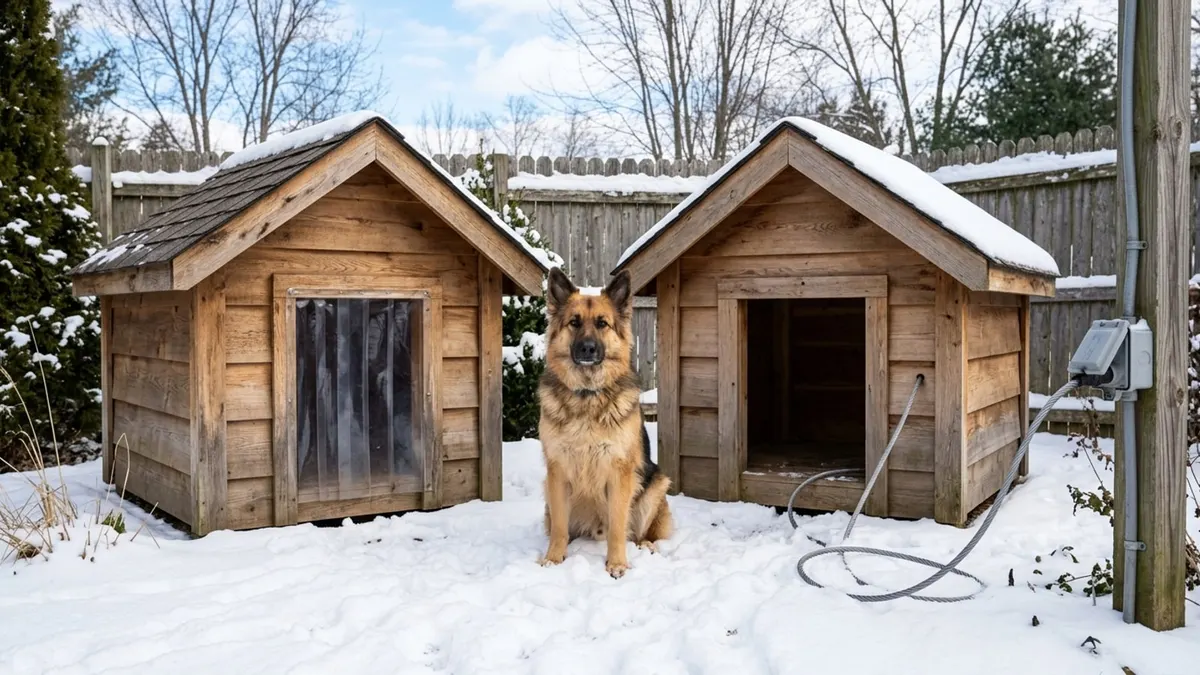
Insulate first. An insulated house with a raised floor, dry bedding and a covered door keeps in the heat the dog makes, uses no power and has nothing in it that can burn. Add heat only if that is not enough, and then as a pad the dog lies on, used with care. The American Veterinary Medical Association says space heaters and heat lamps should be avoided in a dog's shelter because of the risk of burns or fire, and that heated mats can still cause burns. And if the weather or the dog is such that neither will do, the answer is indoors. AVMA says no pet should be left outside for long periods in below-freezing weather.
Side by side
| Insulated house | Heated house or pad | |
|---|---|---|
| Where the warmth comes from | The dog's own body, kept in | The dog's body, plus an electric pad |
| Power | None | 60 to 80 W for a pad; 300 to 800 W for an air heater |
| What AVMA says | A warm, solid shelter is what to provide | Heaters and heat lamps: avoid. Heated mats: with caution |
| What can go wrong | Damp bedding; a house too big to warm | Burns, a chewed cord, a fault |
| Needs | A raised floor, bedding, a door flap | All of that, plus an outdoor outlet and daily checks |
| Examples | FunXplore insulated house, Ketive 55 in | GUTINNEEN heated house, K&H Lectro-Kennel pad |
How a dog house stays warm
A dog house has one heater in it, and it has four legs. Everything else is about keeping that heat from leaving. Humane World for Animals gives the rule that follows: the shelter should be large enough for the dog to move comfortably but small enough to hold in body heat. AVMA adds a floor off the ground, to minimize heat loss into it, bedding that is thick and dry, and a door turned away from the prevailing wind. Insulation is one more layer in that list. The houses that state theirs give 0.6 to 0.78 inch of foam in the walls, floor and roof.
What listings mean by insulated
The word covers very different things. FunXplore's panels are a sandwich of 0.47 inch fir, 0.6 inch foam and 0.12 inch plywood, with the foam sealed inside every wall, the roof and the floor. GUTINNEEN's heated houses carry a 0.78 inch liner or foam lining on six sides. Other listings say insulated and give no thickness or material at all, and some wooden houses claim only that thick timber insulates naturally. No listing we read gives an insulation rating such as an R-value, so thickness and coverage are the only things that can be compared. Ask where the insulation is, how thick it is, and whether the floor has any.
What added heat does, and what it risks
A heated pad warms the dog where it lies. The makers set them low: K&H says its soft bed warms to the pet's normal body temperature and only when occupied, GUTINNEEN gives 89 to 116 F for its pad, and PETNF 100.4 to 107.6 F. AVMA's two sentences on the subject are the whole of the veterinary guidance we found. Space heaters and heat lamps should be avoided because of the risk of burns or fire. Heated pet mats should also be used with caution because they are still capable of causing burns. The Consumer Product Safety Commission's recall list has two entries for heated pet products, in 2010 and 2012, both for fire or shock hazards. Neither is a product on this site, but they are why the caution exists.
What each costs to run
Insulation costs nothing to run. For heat, the arithmetic is watts times hours. An 80 watt pad left on for 24 hours uses 1.92 kilowatt-hours; a 60 watt pad, 1.44. Pads with thermostats draw less than that, since they are not at full power all the time. A 400 watt air heater running half the time uses 4.8 kilowatt-hours a day, and an 800 watt one twice that. Multiply by the rate on your electricity bill. These are our sums from the makers' wattages, and the half-time figure is an assumption for illustration.
Which dogs, which weather
The dog decides more than the house does. A veterinarian quoted by AKC says thick double-coated breeds such as Huskies and Malamutes can usually stay out for 30 minutes to an hour below 32 F, and that small, single-coated and hairless dogs should be kept to 10 to 15 minutes. AKC lists small dogs, old dogs, puppies and short-coated dogs as losing body heat fastest, and AVMA adds dogs with diabetes, heart disease, kidney disease or hormonal problems. The federal rules for licensed kennels do not allow sick, infirm, aged or young dogs, or breeds that cannot tolerate the local temperatures, to be housed outdoors without a veterinarian's approval. For those dogs neither an insulated nor a heated house is the answer.
The order to do things in
- Ask whether the dog should be outside in this weather at all.
- Get the house the right size, off the ground and out of the wind.
- Cover the door.
- Bed it with straw or cedar shavings, as Humane World suggests, and keep the bedding dry.
- Provide unfrozen water, which AVMA says can be done with a pet-safe heated bowl.
- Only then consider a heated pad, covered, with the cord protected and room for the dog to lie off it.
The steps are set out in how to winterize a dog house.
Rules either way
- Check the dog, the bedding and the water every day.
- Know AVMA's signs of trouble: whining, shivering, anxiety, slowing down or stopping, weakness, looking for somewhere warm to burrow. They mean bring the dog in.
- Do not use a heat lamp or a household space heater in a dog house.
- In summer, the insulated box is the wrong place: Humane World says a doghouse makes heat worse. Provide open shade.
Insulated houses are compared on insulated dog houses, heated ones on heated dog houses, pads on heated dog pads and air heaters, with AVMA's objection to them, on dog house heaters.
Frequently asked questions
Is an insulated or heated dog house better?
Insulate first. AVMA's list for a winter shelter is a warm, solid house out of the wind with a raised floor and thick dry bedding, and it says heaters should be avoided and heated mats used with caution. Heat is an addition to a well-set-up house, not a substitute for one.
Do dog houses need heat in winter?
Not as a rule. A right-sized, raised, bedded house with a covered door holds the dog's own heat. Dogs that cannot cope with that, the small, old, young, ill and short-coated, should be indoors in cold weather.
How much electricity does a heated dog house use?
An 80 watt pad uses 1.92 kilowatt-hours if on for 24 hours, and less with a thermostat. A 400 watt air heater running half the time uses about 4.8 kilowatt-hours a day. Those are our sums from the makers' wattages.
Is it OK to put a heat lamp or space heater in a dog house?
AVMA says space heaters and heat lamps should be avoided because of the risk of burns or fire.
What is the warmest kind of dog house?
One that is the right size, off the ground, bedded and draft-free. Among listings that state insulation, the thickest are 0.78 inch foam on six sides (GUTINNEEN XL) and 0.6 inch (FunXplore).
When is a dog house not enough?
AVMA says no pet should be left outside for long periods in below-freezing weather. A veterinarian quoted by AKC limits small dogs to 10 to 15 minutes below 32 F and thick-coated breeds to about 30 minutes to an hour.
Sources
- Cold weather animal safety, American Veterinary Medical Association
- How to Keep Pets Warm in Cold Weather, Humane World for Animals
- How to Keep Pets Safe in High Temperatures, Humane World for Animals
- Table: Special Needs of Outdoor Dogs, MSD Veterinary Manual
- 9 CFR 3.4: Outdoor housing facilities, Legal Information Institute, Cornell Law School
- Hypothermia in Dogs: How Cold Is Too Cold?, American Kennel Club
- How Long Can You Keep Your Dog Outside?, American Kennel Club
- Recalls & Product Safety Warnings, US Consumer Product Safety Commission
Cover image: Illustration: Dog Kennel Review (AI-generated)
Related guides
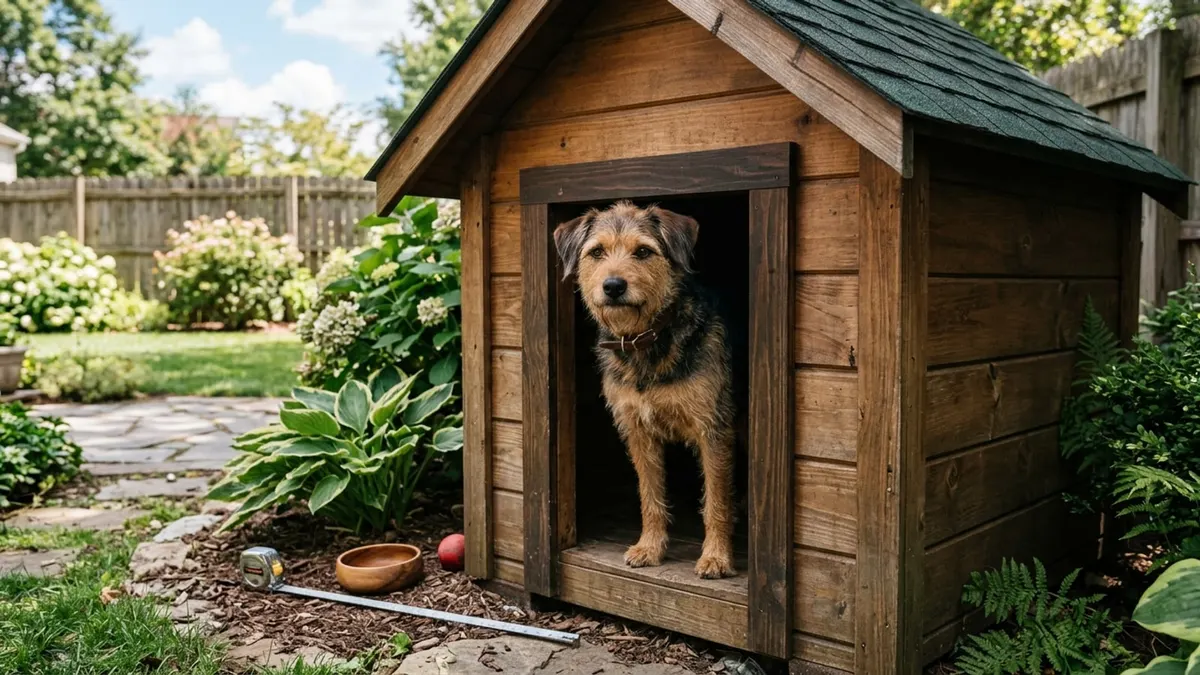
Dog House Size Guide: Big Enough to Turn Around, Small Enough to Stay Warm
How to measure your dog and pick a house that fits.
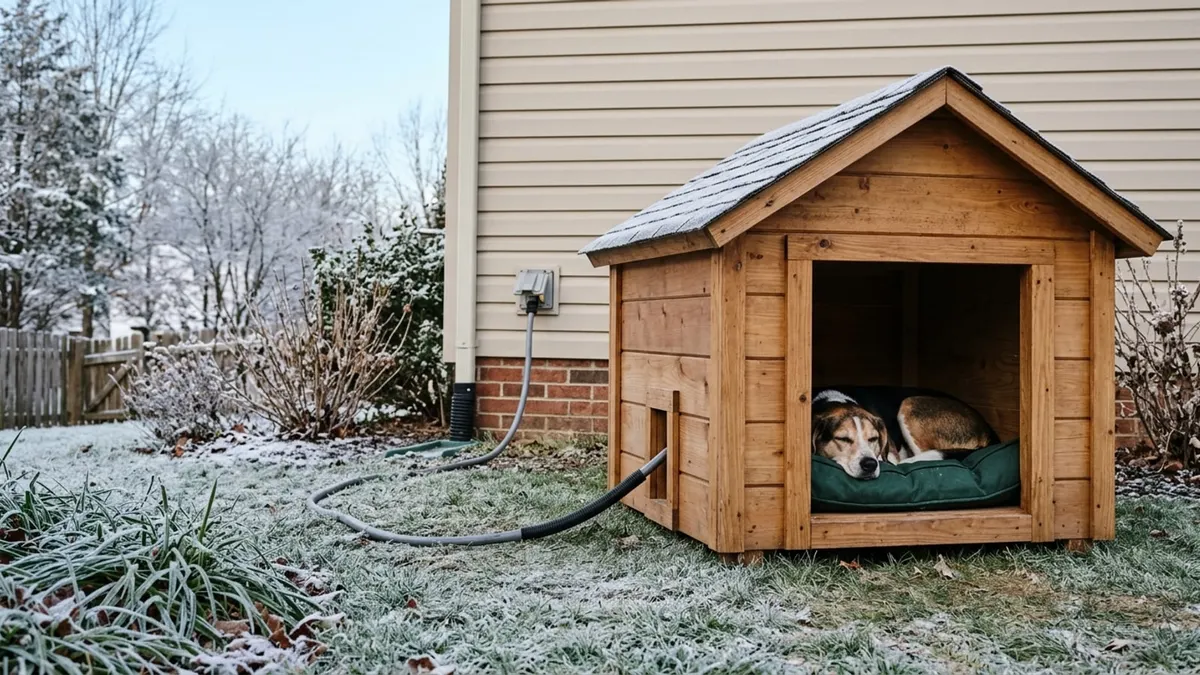
Heated Dog Houses: Insulated Houses With Built-In Heating Pads (2026)
Insulated houses that come with a thermostat heating pad.
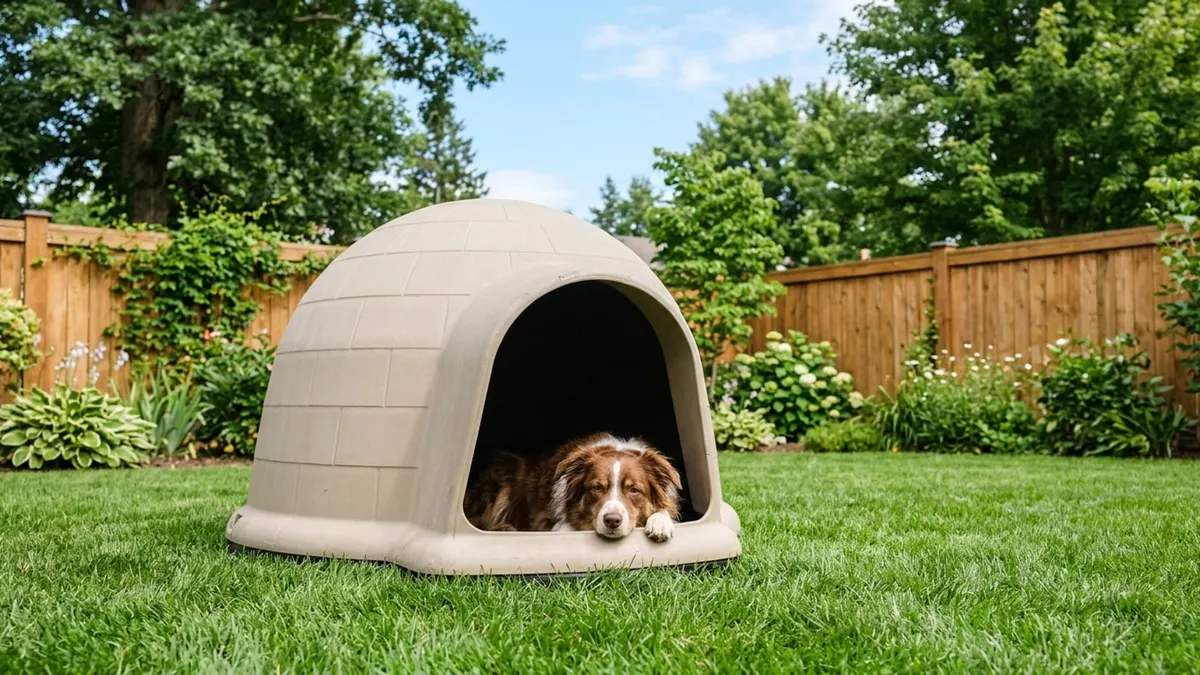
Igloo Dog Houses: Dome Shelters and What Is in Stock (2026)
Dome houses for wind and wet, from small to 90 pound dogs.