
Where to Put a Dog Kennel: Ground, Shade, Wind and Neighbors
Where to put a dog kennel: level drained ground, afternoon shade, the door away from the prevailing wind, close to the house, and away from hazards and boundaries.
Affiliate disclosure: product links on this page go to Amazon or to the maker's own store. As an Amazon Associate we earn from qualifying purchases, at no extra cost to you; links to makers' own stores earn us nothing. No retailer or brand sees our picks before they are published or has any say in them. How we choose.
Put the kennel on level ground that drains, where part of it is in shade all afternoon, with the dog house door turned away from the prevailing wind, and close enough to the house that you see and hear the dog. Each of those comes from a source: the federal rules for licensed kennels on dry floors and shade, the American Veterinary Medical Association on wind, and MSD's veterinary manual on company. Then check two practical things before you build: where the water and the power will come from, and what your city says about where a kennel may stand.
Checklist
- Level and drained. The rules for licensed kennels say an enclosure must let dogs stay dry and clean. Avoid the low corner where water stands after rain, and the foot of a slope.
- Shaded in the afternoon. The same rules require shade for every dog at once. The afternoon sun comes from the south and west, so shade on those sides counts for most.
- Tree shade if you have it. Humane World for Animals says tree shade is ideal because it does not obstruct air flow.
- Sheltered from the prevailing wind. AVMA says a shelter's door should be positioned away from it. A wall, fence or hedge to windward does more than any flap.
- In sight of the house. MSD's veterinary manual says outdoor dogs need frequent human contact. A kennel by the back door gets visited; one at the end of the yard does not.
- Within reach of water and power. AVMA requires unfrozen water in winter. Heated bowls have cords of 5.5 to 6.6 feet by their makers' figures, so the outlet has to be close.
- Off hot surfaces. AVMA warns that asphalt and similar surfaces burn paws. Do not stand a kennel on a driveway in the sun.
Walk the yard first
A site is easier to judge by watching it than by measuring it. Before you choose, look at the yard four times.
- After heavy rain: where does water stand, and for how long?
- At three in the afternoon on a hot day: where is the shade?
- On a windy day: which way does it come from, and what blocks it?
- From the kitchen window and the back door: which spots can you see?
The place that is dry in the first, shaded in the second, sheltered in the third and visible in the fourth is the place.
Getting to it
You will walk to this kennel at least twice a day in all weather, carrying water, food, bedding and a waste bucket. Put the gate on the side facing the house, within reach of a hose, on a path you can use in the dark and in snow. That is our advice, not a source's, but the sources depend on it: bedding gets changed and water gets refilled when doing so is easy.
Sun through the year
Summer and winter want opposite things. In summer the dog needs shade and moving air; in winter it needs the sun and shelter from wind. A spot under a deciduous tree on the south or west side gives shade when the tree is in leaf and sun when it is bare. That observation is ours, not a source's, but it satisfies both seasons' advice at once. Do not rely on the dog house for summer shade. Humane World says a doghouse makes heat worse.
Hazards to keep away from
- Treated lawn and garden beds. AVMA says to follow the instructions on lawn and garden products about how long to keep pets off treated areas, and to store fertilizer and insecticide out of reach.
- Cocoa bean mulch, which AVMA says contains the same toxin as chocolate.
- The driveway and garage door. AVMA and ASPCA both warn that antifreeze is deadly even in small amounts, and spills happen where cars park.
- De-icing salt. AVMA says de-icers can make a pet sick if swallowed. Keep the kennel clear of where you salt.
- Things to climb. A kennel beside a woodpile, a low wall or the boundary fence gives a dog a way over.
Neighbors and rules
Check your local ordinances before you set posts. AKC notes that many municipalities regulate how dogs are kept outdoors, including the amount of space, and that breaking the rules can mean a fine or losing the dog. Setbacks from property lines, limits on structures and noise rules differ from town to town, and we cannot tell you yours. A kennel away from the boundary is also a kennel with fewer passers-by to bark at.
Inside the kennel
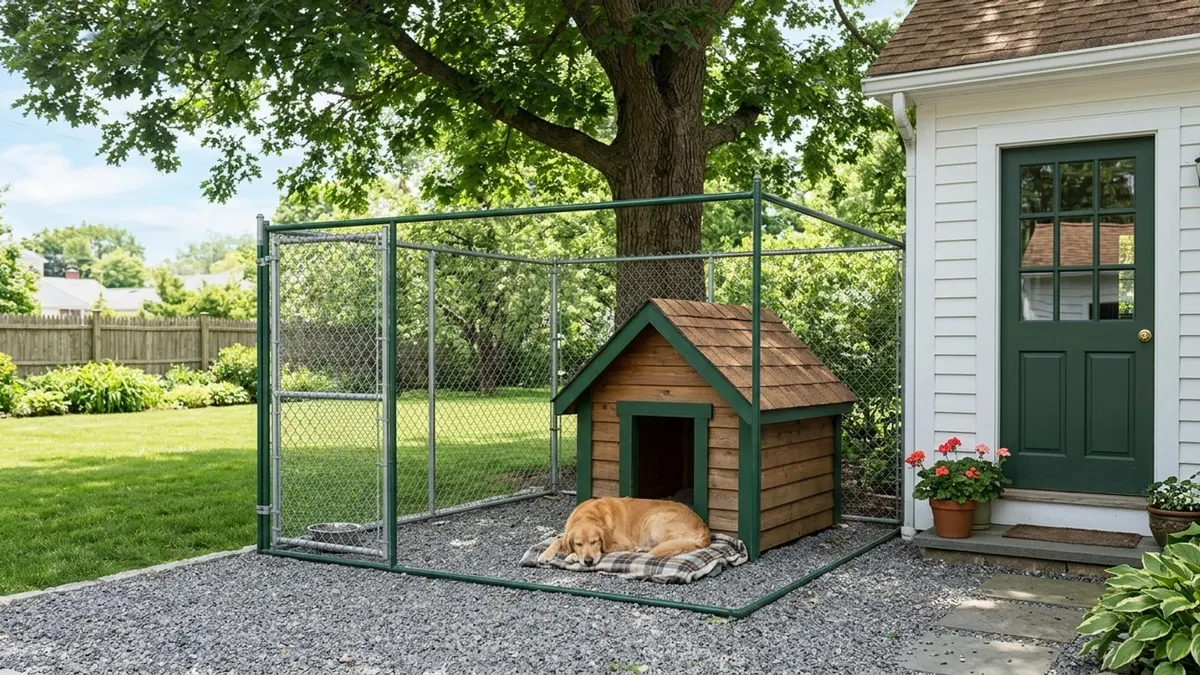
Once the pen is placed, place what goes in it. The dog house goes at the sheltered end with its door away from the wind. The water goes in the shade, outside the house so spills do not wet the bedding. The open shade goes over the rest. The federal rules ask for exactly that arrangement: a shelter with a roof, four sides and a floor, and a separate shaded area large enough for every dog.
Then build
Lay the base before the fence: see kennel flooring. Work out the size with the space calculator, choose a pen from outdoor kennels, and read how to set up a dog run for the order of work. And remember what the kennel is for. AVMA does not recommend keeping any pet outside for long periods, and AKC advises bringing dogs in before bedtime.
Frequently asked questions
Where is the best place for an outdoor dog kennel?
On level, drained ground with afternoon shade, sheltered from the prevailing wind, in sight of the house and within reach of water and power. Those points come from the federal kennel rules, AVMA and MSD's veterinary manual.
Should a dog kennel be in sun or shade?
It needs shade over part of it whenever the dog is in it: the federal rules for licensed kennels require shade for every dog at once, and AVMA says a dog outside needs access to shade. Winter sun is welcome, which is the case for a spot under a deciduous tree.
Which way should a dog house door face?
Away from the prevailing wind, AVMA says. The federal rules for licensed kennels also require a windbreak and rain break at the entrance.
How far from the house should a kennel be?
Close enough that you see and visit the dog. MSD's veterinary manual says outdoor dogs need frequent human contact. Local rules may set minimum distances from property lines, so check them.
Can I put a dog kennel on concrete?
Yes, with shade over it. Concrete drains and hoses clean, but AVMA warns that hot surfaces can burn paws, and a slab is cold in winter, so add tiles, a raised bed and a house with a floor.
What should I keep a kennel away from?
Recently treated lawn, cocoa bean mulch, the driveway where antifreeze and de-icer collect, and anything the dog could climb to get over the fence. AVMA lists the first four as hazards.
Sources
- 9 CFR 3.6: Primary enclosures, Legal Information Institute, Cornell Law School
- 9 CFR 3.4: Outdoor housing facilities, Legal Information Institute, Cornell Law School
- Cold weather animal safety, American Veterinary Medical Association
- Warm weather pet safety, American Veterinary Medical Association
- Table: Special Needs of Outdoor Dogs, MSD Veterinary Manual
- How to Keep Pets Safe in High Temperatures, Humane World for Animals
- How Long Can You Keep Your Dog Outside?, American Kennel Club
- Cold Weather Safety Tips, ASPCA
Cover image: Illustration: Dog Kennel Review (AI-generated)
Related guides
How to Winterize a Dog House: Size, Floor, Door, Bedding, Water
Seven steps to a warm, dry winter shelter, and when to bring the dog in.
Is It Safe to Keep a Dog Outside? What Vets and Welfare Groups Say
The basics an outdoor dog needs, and the limits that override them.
Keeping Outdoor Dogs Cool: Shade, Water and Heat Stroke Signs
Shade, water and the warning signs that mean a vet visit now.